
SS-31: A Peptide With a Mitochondrial Address
Last updated: October 2026
Most molecules wander through a cell. SS-31 was built to arrive somewhere specific: the inner membrane of the mitochondria, the folded wall where most of a cell's energy is made. Here is who designed it and why, the unusual lipid it keeps finding there, what twenty years of papers have actually measured, and how an SS-31 batch is tested.
A Peptide Designed to Find Mitochondria
MOTS-c was discovered. SS-31 was designed, on purpose, by two chemists who wanted a molecule that would go straight to the mitochondria.
In the early 2000s, Hazel Szeto, a pharmacologist at Weill Cornell Medical College in New York, and Peter Schiller, a peptide chemist at the Clinical Research Institute of Montreal, were building a family of very small peptides. The trick was in the pattern: aromatic amino acids alternating with positively charged ones. That combination let the peptides slip across cell membranes and, once inside, gather at the inner mitochondrial membrane.
The family took its name from the two of them: the Szeto-Schiller, or SS, peptides. Number 31 became the lead compound. Its sequence is just four amino acids long, D-Arg-Dmt-Lys-Phe-NH2, and it includes a building block you won't find in ordinary proteins: 2′,6′-dimethyltyrosine, or Dmt.
Over the years SS-31 picked up several other names as it moved through research and development: MTP-131, Bendavia and, as its international nonproprietary name, elamipretide. Research-grade SS-31 is made by chemical peptide synthesis and supplied as a freeze-dried powder.
- 4 amino acids
D-Arg-Dmt-Lys-Phe-NH2 - Designed, not discoveredSzeto (Cornell) and Schiller (Montreal)
- First described in 2004Zhao et al., Journal of Biological Chemistry
- Also calledElamipretide, MTP-131, Bendavia
- CAS 736992-21-5Free base, about 639.8 g/mol
Why Researchers Pay Attention to SS-31
Three findings explain why SS-31 shows up in so much mitochondrial research. Each one comes from a published paper.
It goes where few molecules can
Most compounds that reach mitochondria stay in the fluid around them. In the founding paper, the SS peptides crossed cell membranes and concentrated about 1,000-fold at the inner mitochondrial membrane, the cell's energy-making surface.
Zhao et al., 2004
It finds one particular lipid
Using a glowing version of the peptide, researchers showed SS-31 binds tightly to cardiolipin, a fat molecule found almost nowhere in the cell except that inner membrane. Find cardiolipin, and you've found the energy machinery.
Birk et al., 2013
It changes the membrane surface
Biophysics work showed SS-31 settles into the membrane's surface layer without breaking it apart, and shifts the electrical charge across that surface. That gives researchers a physical handle on how a four-letter peptide could matter.
Mitchell et al., 2020
Meet Cardiolipin: SS-31's Address
To understand SS-31 you have to understand the membrane it goes to, and the unusual lipid that marks it.

Schematic, not to scale. A mitochondrion is roughly a thousand times wider than a single SS-31 molecule.
Why cardiolipin matters
A mitochondrion has two membranes. The outer one is smooth. The inner one is folded into ridges called cristae, which pack in more surface for the protein machines that make ATP. Cardiolipin is a lipid found almost exclusively in that inner membrane.
The 4 Amino Acids of SS-31
Four building blocks, two of them unusual. Hover over or tap each one to see what it is and why it's there.
Aromatic, positive, positive, aromatic: that alternating pattern is the signature of the SS peptides. With its free N-terminus and amidated C-terminus, SS-31 carries three positive charges at neutral pH.
| Sequence | D-Arg-Dmt-Lys-Phe-NH2 (Dmt = 2′,6′-dimethyl-L-tyrosine) |
|---|---|
| Molecular formula | C32H49N9O5 (free base) |
| Molecular weight | About 639.8 g/mol (free base) |
| Monoisotopic mass | 639.3857 Da |
| CAS number | 736992-21-5 (free base) |
| PubChem CID | 11764719 |
| Other names | Elamipretide, MTP-131, Bendavia, SS31 |
Twenty Years of SS-31 Research
From a chemistry idea to a clinical program, here's how the story unfolded, one chapter at a time. Keep scrolling.
- 2004
A peptide with a destination
Zhao et al., Journal of Biological Chemistry · neuronal cells, isolated mitochondria and an isolated heart model
Szeto, Schiller and colleagues described their mitochondria-targeted peptides and found they crossed cell membranes and concentrated about 1,000-fold at the inner mitochondrial membrane. In neuronal cells under oxidative stress, the peptides lowered reactive-oxygen levels and cell death at nanomolar concentrations. In isolated mitochondria they cut reactive-oxygen production, held back swelling and the permeability transition, and stopped cytochrome c from being released. In an isolated heart model they improved contractile force after blood flow was restored. Versions without Dmt didn't reduce reactive-oxygen production or swelling and didn't help the heart model, so that unusual amino acid was doing real work.
- 2013
Finding the partner
Birk et al., Journal of the American Society of Nephrology · fluorescent peptide analog, rat kidney model
Nine years in, the big question was what SS-31 actually binds. Using a version of the peptide that glows when it lands in a fatty environment, the team showed it binds cardiolipin with high affinity, and that the pair shields cytochrome c's iron so it can't act as the peroxidase that damages cardiolipin. In rats given SS-31 before a kidney blood-flow interruption, the cristae kept their structure and the mitochondria didn't swell. ATP came back promptly once blood flow returned, the cells rebuilt their internal scaffolding and polarity faster, fewer cells died, and kidney function was better preserved than in untreated animals.
- 2014
Naming the target
Szeto, British Journal of Pharmacology · review
Szeto pulled a decade of work together and framed SS-31 as the first compound designed around cardiolipin. The review explains why that lipid is so central: it shapes the cristae, holds the energy-making complexes together, and decides whether cytochrome c carries electrons or acts as a peroxidase. SS-31 binds cardiolipin through both charge and fat-loving contacts; in the work reviewed, that kept cytochrome c in its electron-carrying role, protected cristae structure and supported oxidative phosphorylation. The review also summarises animal studies across many conditions that share failing cellular energy.
- 2019
Ageing muscle, measured
Campbell et al., Free Radical Biology and Medicine · young and aged mice
Researchers at the University of Washington worked with young (5-month) and aged (26-month) female mice over eight weeks. Measured inside living muscle, SS-31 reversed the age-related drop in maximum mitochondrial ATP production and in how tightly oxygen use was coupled to ATP making. The aged muscle's redox balance shifted back toward the young profile, with a broad reversal of protein modifications linked to oxidative stress. Treated aged mice had more fatigue-resistant, heavier calf muscle and ran longer on the treadmill, all without making more mitochondria: the existing ones simply worked better.
- 2020
How it sits in a membrane
Mitchell et al., Journal of Biological Chemistry · model membranes and isolated mitochondria
A biophysics team at the University of Connecticut asked a simple question: what does SS-31 physically do to a membrane? It settles into the surface layer, more strongly as the surface gets more negatively charged, and doesn't destabilize the bilayer even at the highest amounts tested, though it does subtly change how the lipids pack. Its clearest effect was on surface charge, in both model and real mitochondrial membranes. As a proof of concept, that changed how calcium was distributed at the surface and eased the energy cost of calcium stress in mitochondria, a physical explanation for much of the earlier biology.
- 2020
Mapping its neighbours
Chavez et al., PNAS · chemical cross-linking with mass spectrometry, isolated mitochondria
Instead of guessing, this team chemically stapled SS-31 to whatever it touched inside mitochondria, then identified the partners with mass spectrometry. Every protein they found was already known to bind cardiolipin. They fell into two groups: the oxidative phosphorylation machinery that makes ATP, and the enzymes of 2-oxoglutarate metabolism. The spots where SS-31 attached often sat right next to where those proteins grip cardiolipin, giving a first map of where SS-31 sits among the cell's energy machinery.
- 2021
Into a clinical trial
Thompson et al., Genetics in Medicine · phase 2/3 trial in Barth syndrome
Barth syndrome is a rare genetic condition in which cardiolipin itself is abnormal, which made it a natural place to test elamipretide as an investigational medicine. The trial had a randomized, placebo-controlled crossover part with 12 participants, then an open-label extension. Neither primary endpoint was met in the randomized part; the paper reports both parts in full.
- 2025
A separate, approved medicine
US FDA · regulatory decision
In September 2025 the US FDA granted accelerated approval to Forzinity, an elamipretide hydrochloride drug product from Stealth BioTherapeutics, for Barth syndrome. That is a separately manufactured, regulated medicine. In Canada, Health Canada's Drug Product Database lists no elamipretide product.
So where does that leave us? SS-31 is one of the most studied molecules in mitochondrial research, and one of very few research peptides whose sequence also became an approved medicine somewhere in the world. Most of what we know about how it works comes from membranes, isolated mitochondria, cells and animals. Each paper speaks for its own model and conditions, so the references below link every original.
Where SS-31 Research Is Heading
Twenty years in, the most interesting questions about SS-31 are still open. These are the ones researchers keep coming back to.
Is surface charge the whole story?
The 2020 membrane work proposed that tuning the charge on the membrane surface could explain much of what SS-31 does, but the authors framed it as one of several non-exclusive mechanisms. Which of them matters most, and in which cells, is still being tested.
Mitchell et al., 2020
Why cardiolipin, and what does it reveal?
SS-31 binds cardiolipin through both charge and fat-loving contacts, and its protein neighbours sit right where those proteins grip cardiolipin. Exactly how that helps cristae keep their shape is a window into how the energy machinery holds itself together.
Szeto, 2014 · Chavez et al., 2020
Why some models respond more than others
The clearest changes so far come from isolated mitochondria, kidney and heart models and ageing muscle in animals. Understanding why some systems respond strongly and others less so is one of the field's central puzzles.
Birk et al., 2013 · Campbell et al., 2019
Designing the next peptide
Knowing exactly how SS-31 sits in a membrane gives chemists a blueprint. The 2020 biophysics team wrote that these details should help design future variants of the peptide, the same way the original SS series was built: on purpose, one residue at a time.
Mitchell et al., 2020
In the clinic, separately. ClinicalTrials.gov lists more than 20 studies of elamipretide as an investigational medicine since 2012, across heart, muscle, eye and rare mitochondrial conditions. Several earlier trials did not meet their primary endpoints, and a phase 3 study in dry age-related macular degeneration (ReNEW, NCT06373731) is still active. Those studies use a separately manufactured, regulated drug product; the SS-31 supplied here is a research-grade peptide for laboratory study.
SS-31 vs MOTS-c: Two Mitochondrial Peptides
They're often mentioned together, but they come from opposite directions. SS-31 was designed in a lab to go to mitochondria; MOTS-c is a message mitochondria write themselves. Read the MOTS-c research guide for its side of the story.
| SS-31 | MOTS-c | |
|---|---|---|
| Origin | Fully synthetic, from the Szeto-Schiller peptide series | Natural sequence encoded in mitochondrial DNA (12S rRNA) |
| Length | 4 amino acids | 16 amino acids |
| Sequence | D-Arg-Dmt-Lys-Phe-NH2 | MRWQEMGYIFYPRKLR |
| Unusual residues | D-arginine and 2′,6′-dimethyltyrosine (Dmt) | None; all standard L-amino acids |
| Molecular weight | About 639.8 g/mol | About 2174.6 g/mol |
| CAS number | 736992-21-5 | 1627580-64-6 |
| Research focus | Cardiolipin and the inner mitochondrial membrane | Metabolic signalling, AMPK, nuclear gene expression |
Reading an SS-31 COA
A research guide is only as good as the material on the bench. A certificate of analysis answers four questions about an SS-31 batch, and the salt form explains why different listings quote different weights.
Identity
Mass spectrometry measures the molecule's mass. An SS-31 result should sit close to 639.39 Da (monoisotopic) or 639.8 Da (average) for the peptide itself.
Purity
HPLC separates the sample and reports what share of the peptide signal is SS-31 rather than shorter or modified synthesis by-products.
Content
A milligram result for the tested vial, read against the 10 mg on the label.
Endotoxin
The LAL test measures bacterial endotoxin, a contaminant that can skew cell-based experiments.
What's actually in a 10 mg vial?
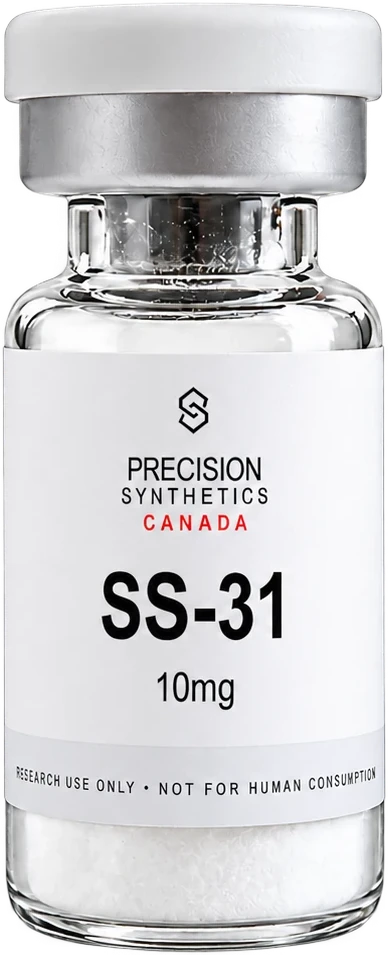
SS-31 carries three positive charges, so after purification each molecule is paired with three small, negatively charged partners called counter-ions, usually acetate, chloride or TFA (trifluoroacetate). They add weight to the powder but no SS-31. That's why 10 mg of powder in the TFA form holds only about 6.5 mg of SS-31, and about 7.8 mg in the acetate form.
The identity test isn't affected: mass spectrometry reads the SS-31 molecule itself at about 639.8 whichever partner it came with. Where it matters is the content line. A good COA says whether its milligram figure means SS-31 itself (net peptide content) or the powder as weighed, so you know exactly what you're working with.
When reading an SS-31 COA, match the batch number on the vial to the report and check that the sample is named as SS-31 or elamipretide. SideChain Analytics, our primary laboratory, is testing our SS-31 batch for identity, purity and endotoxin. The report will be posted on our COA page and on the SS-31 product page as soon as results are available, and each report can be verified directly with the issuing lab.
Common SS-31 Research Questions
What does SS-31 stand for?
SS stands for Szeto-Schiller, after Hazel Szeto and Peter Schiller, who designed the peptide series. 31 is the compound's number within it. Related compounds such as SS-02 and SS-20 come from the same work and have different sequences.
Is SS-31 the same as elamipretide?
Yes, as a molecule. Elamipretide is the international nonproprietary name for the SS-31 sequence, and MTP-131 and Bendavia are earlier development names. The sequence D-Arg-Dmt-Lys-Phe-NH2 and CAS number 736992-21-5 (free base) confirm that two listings describe the same compound. Forzinity is the brand name of one approved drug product only.
What is cardiolipin?
A phospholipid found almost exclusively in the inner mitochondrial membrane. It helps shape the cristae, holds the energy-making protein complexes together and binds cytochrome c. Published studies describe SS-31 binding cardiolipin with high affinity.
Why does SS-31 contain Dmt?
Dmt, 2′,6′-dimethyltyrosine, is a modified tyrosine designed into the SS peptides. In the founding 2004 paper, versions without Dmt did not reduce mitochondrial reactive-oxygen production in the tests used, while those with it did.
Has SS-31 been studied in people?
Yes. Elamipretide has been tested as an investigational medicine in clinical trials, including a phase 2/3 trial in Barth syndrome published in 2021, and a separately manufactured elamipretide drug product received US FDA accelerated approval in 2025. Research-grade SS-31 supplied for laboratory study is a different thing from that regulated medicine.
Why do listings show different molecular weights for SS-31?
The free base weighs about 639.8 g/mol. Salt forms carry counter-ions that raise the figure: about 749 g/mol as the trihydrochloride, 820 as the triacetate and 982 as the tris-TFA salt. Some listings simply print the wrong formula. Comparing the sequence and CAS number is the reliable check, and the batch COA states which form was tested.
Is SS-31 approved by Health Canada?
No. Health Canada's Drug Product Database lists no elamipretide product. In the United States, an elamipretide drug product sold as Forzinity received FDA accelerated approval in September 2025 for a rare genetic condition. That medicine is separately manufactured and regulated; the SS-31 offered here is a research-grade peptide supplied for laboratory study.
How should unopened vials be stored?
Keep the vial sealed, dry, protected from light and within any conditions stated in its batch documentation. The handling and storage guide covers this in more detail.
When will the SS-31 test results be available?
Results are posted on our COA page and the SS-31 product page as soon as SideChain Analytics completes testing on the batch, and ordering opens at the same time.
Glossary of Terms
Inner mitochondrial membrane
The folded inner wall of a mitochondrion, where the protein complexes that make ATP sit.
Cristae
The folds of the inner membrane, which increase the surface available for energy production.
Cardiolipin
A phospholipid found almost only in the inner mitochondrial membrane, important for cristae shape and the energy complexes.
Cytochrome c
A small protein that carries electrons in the energy chain and can act as a peroxidase when its contact with cardiolipin changes.
Oxidative phosphorylation
The process in the inner membrane that uses oxygen to make most of a cell's ATP.
Dmt
2′,6′-dimethyltyrosine, a modified tyrosine that is not found in ordinary proteins.
D-amino acid
The mirror-image form of an amino acid. Proteins are built from L-amino acids; SS-31 starts with D-arginine.
C-terminal amide
An -NH2 cap on the last amino acid in place of the usual acid group, written as "-NH2" at the end of the sequence.
Barth syndrome
A rare inherited condition caused by changes in the TAZ gene, which lead to abnormal cardiolipin.
Counter-ion
A charged molecule, such as acetate, chloride or trifluoroacetate, paired with a peptide's charged groups in its salt form.
Mass spectrometry
A method that measures molecular mass very precisely, used to confirm a peptide's identity.
HPLC and LAL
HPLC (high-performance liquid chromatography) separates a sample to measure purity. The LAL test detects bacterial endotoxin.
References
- Zhao K et al. (2004). Cell-permeable peptide antioxidants targeted to inner mitochondrial membrane inhibit mitochondrial swelling, oxidative cell death, and reperfusion injury. Journal of Biological Chemistry 279(33):34682–34690. PubMed 15178689
- Birk AV et al. (2013). The mitochondrial-targeted compound SS-31 re-energizes ischemic mitochondria by interacting with cardiolipin. Journal of the American Society of Nephrology 24(8):1250–1261. PubMed 23813215
- Szeto HH (2014). First-in-class cardiolipin-protective compound as a therapeutic agent to restore mitochondrial bioenergetics. British Journal of Pharmacology 171(8):2029–2050. PubMed 24117165
- Campbell MD et al. (2019). Improving mitochondrial function with SS-31 reverses age-related redox stress and improves exercise tolerance in aged mice. Free Radical Biology and Medicine 134:268–281. PubMed 30597195
- Mitchell W et al. (2020). The mitochondria-targeted peptide SS-31 binds lipid bilayers and modulates surface electrostatics as a key component of its mechanism of action. Journal of Biological Chemistry 295(21):7452–7469. PubMed 32273339
- Chavez JD et al. (2020). Mitochondrial protein interaction landscape of SS-31. PNAS 117(26):15363–15373. PubMed 32554501
- Thompson WR et al. (2021). A phase 2/3 randomized clinical trial followed by an open-label extension to evaluate the effectiveness of elamipretide in Barth syndrome, a genetic disorder of mitochondrial cardiolipin metabolism. Genetics in Medicine 23(3):471–478. PubMed 33077895
- US Food and Drug Administration (2025). NDA 215244 accelerated approval letter, Forzinity (elamipretide). FDA approval letter
Related Research
For research use only. Not for human or veterinary use.