
Tirzepatide: Two Incretin Signals in One Peptide
Last updated: October 2026
After a meal, the gut releases two hormones, GIP and GLP-1, that tell the pancreas to release insulin. For decades researchers studied them separately. Tirzepatide is a single 39-amino-acid peptide designed to act at both receptors, and to act at them unequally. Here is where it came from, what the receptor and structural studies show, how it reached approval, and how a tirzepatide batch is tested.
One Peptide, Two Hormones
Tirzepatide was built on the backbone of one hormone and tuned to reach the receptor of another.
GIP and GLP-1 are the incretins, gut hormones that amplify insulin release after eating. GIP was sequenced in 1971 by a team at the University of British Columbia, and GLP-1 was recognised as an insulin-releasing hormone in 1987. Each has its own receptor, GIPR and GLP-1R, and both receptors sit on the beta cells of the pancreas, among other tissues.
In nature, both hormones are cut and inactivated within minutes. Researchers learned to work around that in two ways: swapping in amino acids the cutting enzyme can't recognise, and attaching a fatty acid that lets the peptide ride on albumin in the blood. By 2013, a single peptide active at both incretin receptors had been described in rodents and monkeys.
Tirzepatide, developed by Eli Lilly under the code LY3298176, was described in 2018. Its sequence is based on GIP, with two Aib residues, a C20 fatty diacid on lysine 20, and a tail borrowed from exendin-4, a peptide first found in Gila monster venom. Research-grade tirzepatide is made by chemical synthesis and supplied as a freeze-dried powder.
- 39 amino acidsPlus a C20 fatty diacid side chain
- Dual receptor agonistGIPR and GLP-1R
- First described in 2018Coskun et al., Molecular Metabolism
- Also calledLY3298176
- CAS 2023788-19-2C225H348N48O68, about 4813 g/mol
Why Researchers Pay Attention to Tirzepatide
Three findings explain why tirzepatide is one of the most studied incretin peptides. Each one comes from a published paper.
Built on GIP, reaching GLP-1R too
In receptor assays, tirzepatide bound GIPR about as well as native GIP, and bound GLP-1R about five times more weakly than native GLP-1. It is a GIP-based peptide with a deliberate second target.
Coskun et al., 2018
Imbalanced and biased
At GIPR it behaves much like GIP. At GLP-1R it favours one signal, cAMP, over another, β-arrestin recruitment, and pulls the receptor into the cell less than GLP-1 does. The authors called it imbalanced and biased.
Willard et al., 2020
Seen inside both receptors
Cryo-electron microscopy captured tirzepatide in both receptors. The structures show how its sequence and its fatty acid together shape the way it engages each one.
Sun et al., 2022
Two Receptors, Two Signals
The incretin receptors look alike from the outside. Tirzepatide's story is about how differently it engages each one.
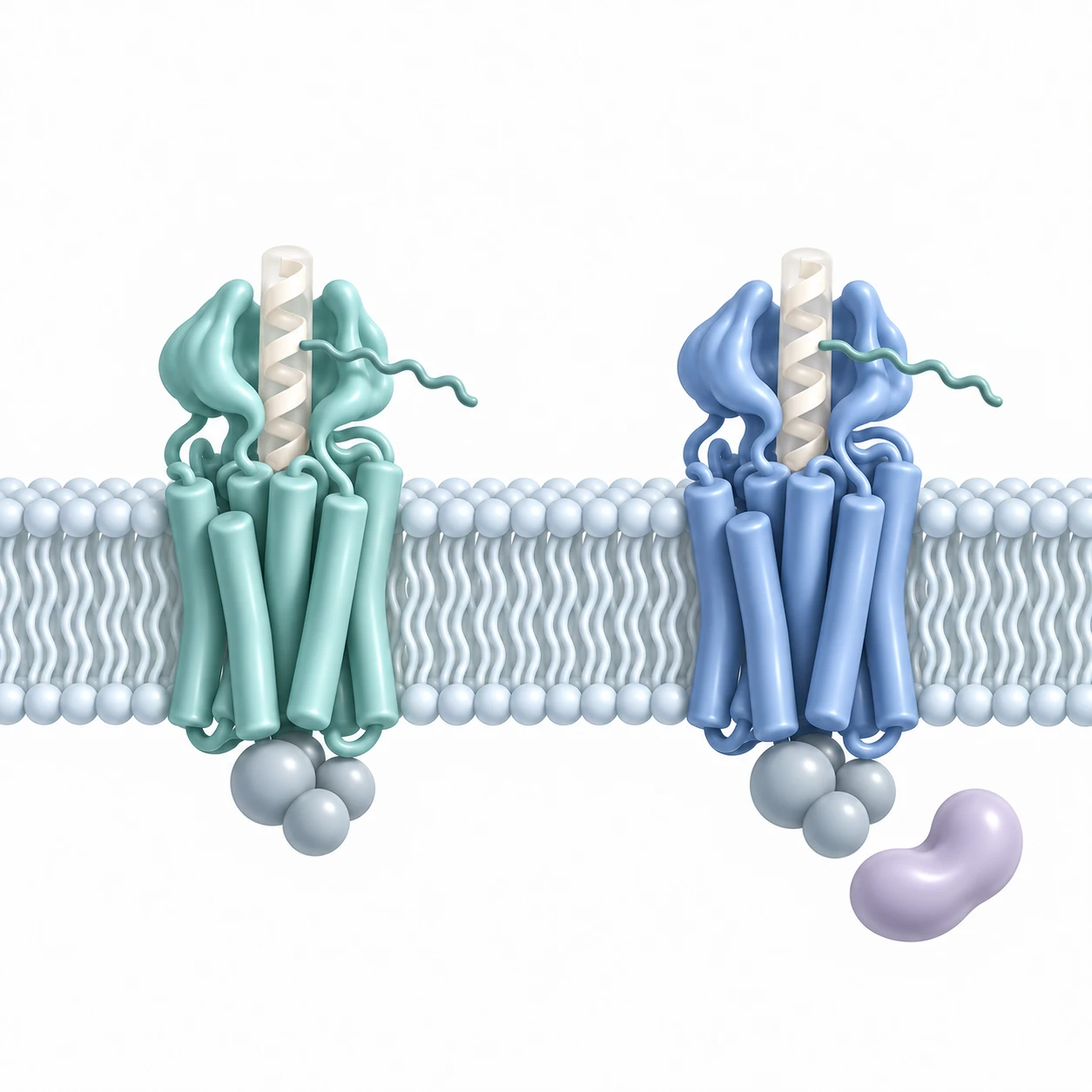
Schematic, not to scale. At GLP-1R, tirzepatide favours the G protein (cAMP) signal and recruits β-arrestin less than GLP-1 does.
GIPR and GLP-1R
Both are class B G protein-coupled receptors. When activated, they raise cyclic AMP (cAMP) inside the cell, and they can also recruit β-arrestin, which helps pull the receptor inside.
The 39 Amino Acids of Tirzepatide
This is the whole chain, start to finish. Hover over or tap any position to see what it is. Look for the two Aib residues and the lysine that carries the fatty acid.
Two Aib residues, at positions 2 and 13, guard the chain against the enzymes that quickly break down GIP and GLP-1. The fatty acid on lysine 20 binds albumin, which keeps the peptide circulating for days.
| Sequence | Y-Aib-EGTFTSDYSI-Aib-LDKIAQ-K*-AFVQWLIAGGPSSGAPPPS-NH2 (* lipidated lysine 20) |
|---|---|
| Molecular formula | C225H348N48O68 |
| Molecular weight | About 4813 g/mol |
| Side chain | A C20 fatty diacid (1,20-eicosanedioic acid) joined to lysine 20 through a linker |
| C-terminus | Amide (-NH2) |
| CAS number | 2023788-19-2 |
| PubChem CID | 156588324 |
| Other names | LY3298176 |
Fifty Years of Research Behind Tirzepatide
From a Canadian gut-hormone discovery to a peptide seen inside its receptors, here is how the story unfolded, one chapter at a time. Keep scrolling.
- 1971
GIP gets a sequence
Brown & Dryburgh, Canadian Journal of Biochemistry · purified intestinal peptide
At the University of British Columbia, John Brown's team purified a peptide from the upper intestine that slowed stomach acid secretion, and in 1971 published its full amino-acid sequence. Its more important job, prompting the pancreas to release insulin after a meal, came into focus soon after, and it became glucose-dependent insulinotropic polypeptide. Tirzepatide's backbone starts here.
- 1987
GLP-1 joins the story
Mojsov et al., Journal of Clinical Investigation · Drucker et al., PNAS · isolated pancreas and islet cells
The glucagon gene turned out to encode a second hormone. In 1987 a fragment called glucagon-like peptide 1 was shown to stimulate insulin release from the perfused rat pancreas, and to raise cAMP and insulin gene activity in islet cells. GIP and GLP-1 became the two incretins, and their receptors the two targets tirzepatide would later combine.
- 1992
A clue from lizard venom
Eng et al., Journal of Biological Chemistry · Gila monster venom
John Eng, working in New York, isolated a 39-amino-acid peptide from the venom of the Gila monster, a desert lizard, and named it exendin-4. It acted at the GLP-1 receptor but resisted the enzyme that breaks down GLP-1. Its last eleven residues, GGPSSGAPPPS, help it hold a folded shape, and that same tail closes the tirzepatide chain today.
- 2013
Two incretins in one molecule
Finan et al., Science Translational Medicine · rodents, monkeys and a first human study
A research network spanning Indiana University and Munich engineered a single peptide active at both the GIP and GLP-1 receptors, and described it in rodents, monkeys and a first human study. It showed that the incretin receptors could be treated as a pair, and that one peptide could be tuned to reach both.
- 2018
LY3298176 is unveiled
Coskun et al., Molecular Metabolism · cell assays, mice and phase 1 studies
Eli Lilly scientists described LY3298176, now named tirzepatide. It bound GIPR about as well as native GIP and GLP-1R about five times more weakly than native GLP-1, and its cAMP signal at GLP-1R was about 13 times weaker. Its half-life in people came out at about five days. The same year, a phase 2 trial in type 2 diabetes was published in The Lancet.
- 2020
Imbalanced and biased
Willard et al., JCI Insight · cell signalling and islet studies
A closer look at signalling explained what makes tirzepatide unusual. At GIPR it mimicked native GIP. At GLP-1R it favoured cAMP over β-arrestin recruitment and drove less receptor internalisation than GLP-1, and islet experiments pointed to β-arrestin1 in that difference. Receptor-occupancy modelling showed it engaging GIPR more than GLP-1R. The paper's title summed it up: imbalanced and biased.
- 2021
Phase 3 begins to report
Rosenstock et al., The Lancet · SURPASS-1, phase 3 trial in type 2 diabetes
SURPASS-1 was the first published trial of the SURPASS phase 3 program, which studied tirzepatide as an investigational medicine in type 2 diabetes. It was randomized, double-blind and placebo-controlled. A second program, SURMOUNT, followed in obesity, with SURMOUNT-1 published in the New England Journal of Medicine in 2022. Their full results are in the original papers, linked below.
- 2022
Seeing it in the receptors
Sun et al., PNAS · cryo-electron microscopy and molecular dynamics
Structures of tirzepatide bound to each receptor showed it sitting in GIPR much as native GIP does, but in GLP-1R in a markedly different way, with less of the agonist-driven desensitisation that GLP-1 causes. The team found that the fatty acid and the amino-acid sequence work together to shape how tirzepatide behaves at each receptor.
- 2022
Approved as a medicine
U.S. FDA, May 2022 · Health Canada, November 2022
The U.S. Food and Drug Administration approved tirzepatide under the brand name Mounjaro in May 2022 for type 2 diabetes, alongside diet and exercise. Health Canada first authorized Mounjaro in November 2022, for glycemic control in adults with type 2 diabetes. Tirzepatide became the first approved medicine to act at both incretin receptors.
- 2023
A second brand in the U.S.
U.S. FDA, November 2023
In November 2023 the FDA approved tirzepatide a second time, under the brand name Zepbound, for chronic weight management in adults. The molecule is the same; the approved use and the brand differ. In Canada, the Mounjaro monograph lists type 2 diabetes. Tirzepatide is also the comparison point for newer multi-receptor peptides such as retatrutide.
So where does that leave us? Tirzepatide shows how far peptide design has come: a GIP-based chain, protected from breakdown, extended with an albumin-binding fatty acid and tuned to reach a second receptor in a deliberately unequal, biased way. Its science runs from cell assays and receptor structures to large clinical programs and regulatory approval. Each paper speaks for its own model, population and conditions, so the references below link every original.
Where Tirzepatide Research Is Heading
Approval didn't close the research questions. These are the ones laboratories keep coming back to.
What does the GIP arm do?
Tirzepatide engages GIPR more than GLP-1R. How much of its biology comes from each receptor, and in which tissues, is one of the field's most debated questions.
Willard et al., 2020
Does bias matter?
Favouring cAMP over β-arrestin at GLP-1R means less receptor internalisation. Whether that keeps the receptor responsive for longer is a question about receptor biology well beyond tirzepatide.
Willard et al., 2020 · Sun et al., 2022
The role of the fatty acid
The C20 diacid was added to extend circulation, but structures suggest it also shapes how the peptide engages its receptors. Separating those two jobs is an open design problem.
Sun et al., 2022
Two receptors or three?
Tirzepatide is now the reference point for triple agonists such as retatrutide, which adds the glucagon receptor. Comparing them helps isolate what each receptor contributes.
Bailey et al., 2025
In the clinic, separately. Tirzepatide is an approved prescription medicine, sold as Mounjaro in Canada and as Mounjaro and Zepbound in the United States. Those are regulated drug products. The tirzepatide supplied here is a research-grade peptide for laboratory study and is not a drug product.
Tirzepatide vs Retatrutide at a Glance
Both are 39-amino-acid, fatty-acid-modified peptides from the same lab. The difference is one receptor.
| Tirzepatide | Retatrutide | |
|---|---|---|
| Receptors | GIPR and GLP-1R (dual) | GIPR, GLP-1R and GCGR (triple) |
| Length | 39 amino acids | 39 amino acids |
| Non-standard residues | Aib at 2 and 13 | Aib at 2 and 20, α-methyl-leucine at 13 |
| Fatty acid on | Lysine 20 | Lysine 17 |
| Reported half-life | About 5 days | About 6 days |
| Status | Approved medicine in Canada and the US | Investigational, phase 3 |
Reading a Tirzepatide COA
A research guide is only as good as the material on the bench. A certificate of analysis answers four questions about a tirzepatide batch.
Identity
Mass spectrometry measures the molecule's mass. A tirzepatide result should sit close to 4813 Da, the mass of the full peptide with its fatty-acid side chain.
Purity
HPLC separates the sample and reports what share of the peptide signal is tirzepatide rather than shorter or modified synthesis by-products.
Content
A milligram result for the tested vial, read against the amount on the label.
Endotoxin
The LAL test measures bacterial endotoxin, a contaminant that can skew cell-based experiments.
What's actually in the vial?
Synthetic peptides usually come out of purification with small charged partners, called counter-ions, attached to their charged groups. A long peptide like tirzepatide has many charged groups, so they add weight to the powder but no peptide, and the milligrams of powder and the milligrams of tirzepatide itself can differ.
The identity test isn't affected: mass spectrometry reads the tirzepatide molecule itself. Where it matters is the content line. A good COA says whether its milligram figure means the peptide itself (net peptide content) or the powder as weighed, so you know exactly what you're working with.
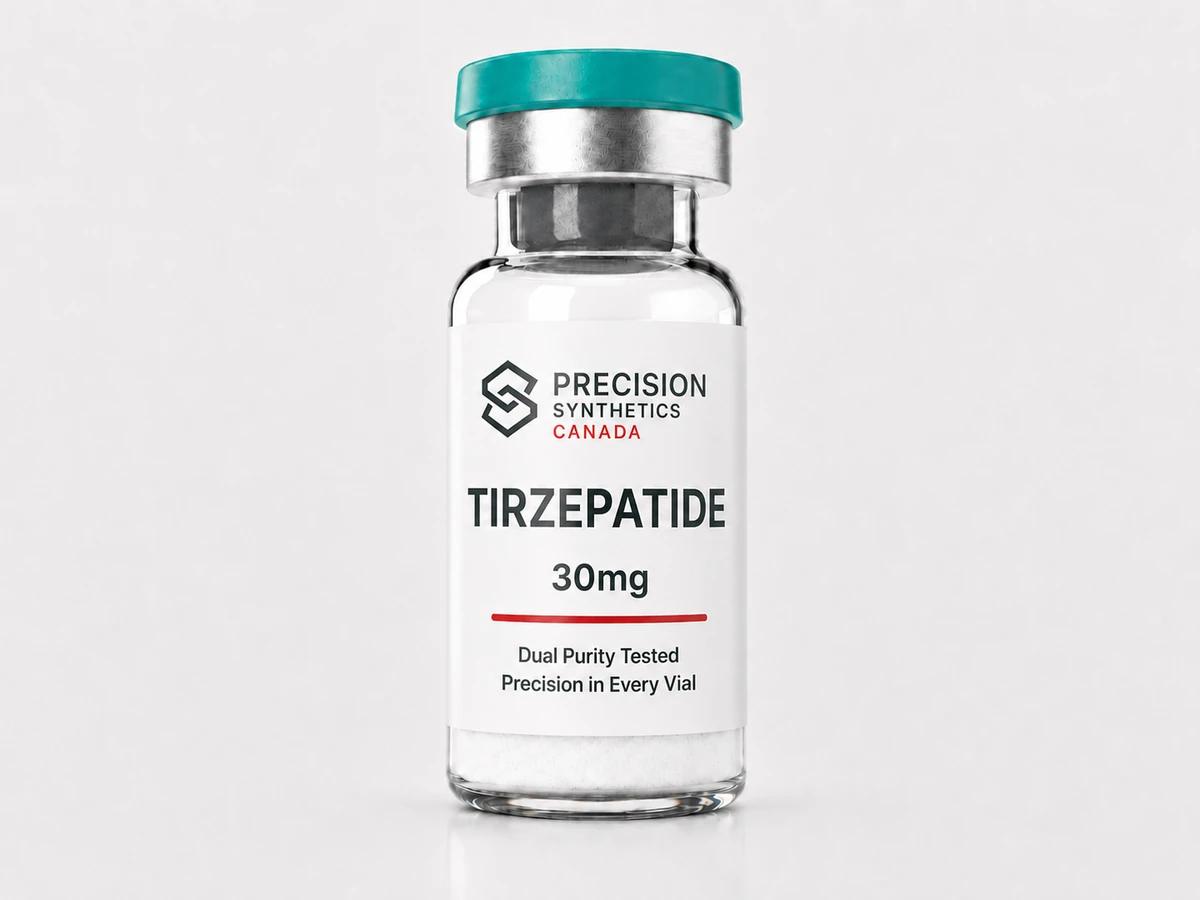
When reading a tirzepatide COA, match the batch number on the vial to the report and check that the sample is named as tirzepatide. Our tirzepatide batches are tested by SideChain Analytics, our primary laboratory in Canada, for identity, content and purity, alongside Janoshik source-lab reports. Every report is on our COA page and the tirzepatide product page, and each one can be verified directly with the issuing lab.
Common Tirzepatide Research Questions
What is tirzepatide?
Tirzepatide (LY3298176) is a synthetic 39-amino-acid peptide with a fatty-acid side chain. It activates two incretin hormone receptors, GIPR and GLP-1R, and has been studied in cell assays, animal models and clinical trials. It is also the active ingredient of approved prescription medicines.
Why is tirzepatide called a dual agonist?
An agonist is a molecule that switches a receptor on. Tirzepatide switches on two receptors, the ones for GIP and GLP-1, so it is a dual agonist. Retatrutide adds a third, the glucagon receptor.
What does "imbalanced and biased" mean?
Imbalanced means tirzepatide engages GIPR more than GLP-1R. Biased means that at GLP-1R it favours one signal, cAMP, over another, β-arrestin recruitment. Both terms come from a 2020 study of its signalling.
Is tirzepatide the same as LY3298176?
Yes. LY3298176 is the development code Eli Lilly used before the name tirzepatide was assigned. CAS number 2023788-19-2 and PubChem CID 156588324 identify the same compound.
How is tirzepatide different from retatrutide?
Both are 39-amino-acid peptides with a C20 fatty acid. Tirzepatide acts at the GIP and GLP-1 receptors; retatrutide also acts at the glucagon receptor. Our comparison guide covers the differences in detail.
Why does tirzepatide last so long?
GIP and GLP-1 are broken down within minutes. Tirzepatide's Aib residues resist the enzyme that cuts them, and its fatty acid binds albumin, a carrier protein in blood. Its half-life was reported at about five days.
Is research-grade tirzepatide the same as Mounjaro?
No. Mounjaro and Zepbound are regulated drug products made and approved for prescription use. Research-grade tirzepatide is supplied for laboratory and analytical research only and is not a drug product.
Is tirzepatide approved by Health Canada?
Yes, as the prescription medicine Mounjaro, first authorized in November 2022 for type 2 diabetes. That authorization covers Mounjaro itself, not research-grade material, which is supplied for laboratory research only.
How should unopened vials be stored?
Keep the vial sealed, dry, protected from light and within any conditions stated in its batch documentation. The handling and storage guide covers this in more detail.
Glossary of Terms
GIP
Glucose-dependent insulinotropic polypeptide, a 42-amino-acid hormone from the upper intestine.
GLP-1
Glucagon-like peptide 1, a hormone from the lower intestine made from the same gene as glucagon.
Incretin
A gut hormone, such as GIP or GLP-1, that amplifies insulin release after eating.
Agonist
A molecule that binds a receptor and switches it on.
Exendin-4
A 39-amino-acid peptide from Gila monster venom that acts at the GLP-1 receptor. Tirzepatide shares its C-terminal tail.
cAMP
Cyclic adenosine monophosphate, a messenger molecule inside cells that rises when these receptors are activated.
β-Arrestin
A protein recruited to activated receptors that helps switch them off and pull them inside the cell.
Biased agonism
When a molecule favours one of a receptor's signals over another.
Aib
α-Aminoisobutyric acid, a non-standard amino acid that protects peptides from enzymatic cleavage.
Fatty diacid
A long-chain fatty acid with an acid group at each end. Attached to a peptide, it binds albumin and slows clearance.
Cryo-electron microscopy
A method that images frozen molecules to reveal their 3D structure, used here to see the peptide inside its receptors.
HPLC and LAL
HPLC (high-performance liquid chromatography) separates a sample to measure purity. The LAL test detects bacterial endotoxin.
References
- Brown JC, Dryburgh JR (1971). A gastric inhibitory polypeptide. II. The complete amino acid sequence. Canadian Journal of Biochemistry 49(8):867–872. PubMed 5120249
- Mojsov S, Weir GC, Habener JF (1987). Insulinotropin: glucagon-like peptide I (7-37) co-encoded in the glucagon gene is a potent stimulator of insulin release in the perfused rat pancreas. Journal of Clinical Investigation 79(2):616–619. PubMed 3543057
- Drucker DJ et al. (1987). Glucagon-like peptide I stimulates insulin gene expression and increases cyclic AMP levels in a rat islet cell line. PNAS 84(10):3434–3438. PubMed 3033647
- Eng J et al. (1992). Isolation and characterization of exendin-4, an exendin-3 analogue, from Heloderma suspectum venom. Journal of Biological Chemistry 267(11):7402–7405. PubMed 1313797
- Finan B et al. (2013). Unimolecular dual incretins maximize metabolic benefits in rodents, monkeys, and humans. Science Translational Medicine 5(209):209ra151. PubMed 24174327
- Coskun T et al. (2018). LY3298176, a novel dual GIP and GLP-1 receptor agonist for the treatment of type 2 diabetes mellitus: from discovery to clinical proof of concept. Molecular Metabolism 18:3–14. PubMed 30473097
- Frias JP et al. (2018). Efficacy and safety of LY3298176, a novel dual GIP and GLP-1 receptor agonist, in patients with type 2 diabetes: a randomised, placebo-controlled and active comparator-controlled phase 2 trial. The Lancet 392(10160):2180–2193. PubMed 30293770
- Willard FS et al. (2020). Tirzepatide is an imbalanced and biased dual GIP and GLP-1 receptor agonist. JCI Insight 5(17):e140532. PubMed 32730231
- Rosenstock J et al. (2021). Efficacy and safety of a novel dual GIP and GLP-1 receptor agonist tirzepatide in patients with type 2 diabetes (SURPASS-1): a double-blind, randomised, phase 3 trial. The Lancet 398(10295):143–155. PubMed 34186022
- Sun B et al. (2022). Structural determinants of dual incretin receptor agonism by tirzepatide. PNAS 119(13):e2116506119. PubMed 35333651
- Jastreboff AM et al. (2022). Tirzepatide once weekly for the treatment of obesity. New England Journal of Medicine 387(3):205–216. PubMed 35658024
- Bailey CJ, Flatt PR, Conlon JM (2025). Multifunctional incretin peptides in therapies for type 2 diabetes, obesity and associated co-morbidities. Peptides 187:171380. PubMed 40081498
Related Research
For research use only. Not for human or veterinary use.