
MOTS-c: The Mitochondrial Messenger
Last updated: October 2026
Your mitochondria are known as the cell's power plants. What surprised researchers is that they also send messages. MOTS-c is one of those messages: a 16-amino-acid peptide written into mitochondrial DNA, not the DNA in the nucleus. Here is how it was found, why it caught researchers' attention, what ten years of papers have actually measured, and how a MOTS-c batch is tested.
A Hidden Message in Mitochondrial DNA
The genome inside mitochondria was supposed to be a short, settled list. It wasn't.
Almost every protein in your body is built from instructions stored in the nucleus. Mitochondria are the exception that proves the rule: they keep their own tiny ring of DNA, a leftover from their ancient past as free-living bacteria. For decades, textbooks gave that ring a short job description: 37 genes, coding for 13 proteins, 22 transfer RNAs and two ribosomal RNAs. That was supposed to be the whole list.
Then small hidden messages started turning up. In 2015, a team led by Changhan Lee and Pinchas Cohen at the University of Southern California found one tucked inside the gene for the 12S ribosomal RNA: a stretch just 51 letters long that spells out a 16-amino-acid peptide. They named it MOTS-c, short for mitochondrial open reading frame of the 12S rRNA type-c. They detected it in rodent tissues and in human and rodent blood, and their mouse experiments pointed to skeletal muscle as the place it mainly acts.
MOTS-c now belongs to a small family called mitochondrial-derived peptides. Its better-known relative, humanin, was described in 2001, and six humanin-like peptides (SHLP1 to SHLP6) sit next door in the 16S rRNA gene. Research-grade MOTS-c is made by chemical synthesis and supplied as a freeze-dried powder with the same 16-residue sequence.
- 16 amino acids
MRWQEMGYIFYPRKLR - Encoded in mitochondrial DNAInside the 12S rRNA gene, MT-RNR1
- First described in 2015Lee et al., Cell Metabolism
- Studied in cells and miceHuman studies measure natural levels in blood and muscle
- CAS 1627580-64-6Free peptide, about 2174.6 g/mol
Why Researchers Pay Attention to MOTS-c
Three things set MOTS-c apart, and each one is a finding from a published paper.
It's made in an unexpected place
Peptides almost always come from nuclear genes. MOTS-c is coded in mitochondrial DNA, inside a gene whose main job is building ribosomes. Finding a working peptide hidden in there changed how researchers read the mitochondrial genome.
Lee et al., 2015
It travels to the control room
Most of what mitochondria make stays put. When cultured cells were put under metabolic stress, MOTS-c moved into the nucleus and worked alongside the cell's own genes there. The power plant, in effect, was sending orders to headquarters.
Kim et al., 2018
Its levels move with exercise
When researchers sampled people before and after a bout of exercise, the MOTS-c they measured in muscle and blood was higher. That is why the 2021 paper's title calls it "exercise-induced". The study measured the body's own MOTS-c; nobody was given any.
Reynolds et al., 2021
Finding 51 Letters in 16,569
Human mitochondrial DNA is a closed ring of 16,569 base pairs. MOTS-c's instructions take up just 51 of them, inside the 12S rRNA gene. Its cousin humanin sits next door, in the 16S rRNA gene.
Zooming in on the ribosomal RNA genes
On the standard human mitochondrial reference map, MOTS-c occupies bases 1343 to 1393, near the end of the 12S rRNA gene. That's less than a third of one percent of the ring.
The 16 Amino Acids of MOTS-c
This is the whole peptide, start to finish. Hover over or tap any amino acid to see what it is, and look for position 14: one letter changed there is the subject of its own research.
Four of the sixteen residues are basic and one is acidic, so the peptide carries a net positive charge at neutral pH.
| Three-letter sequence | H-Met-Arg-Trp-Gln-Glu-Met-Gly-Tyr-Ile-Phe-Tyr-Pro-Arg-Lys-Leu-Arg-OH |
|---|---|
| Molecular formula | C101H152N28O22S2 (free peptide) |
| Molecular weight | About 2174.6 g/mol (free peptide) |
| Monoisotopic mass | 2173.1077 Da |
| CAS number | 1627580-64-6 |
| PubChem CID | 146675088 |
| UniProt | A0A0C5B5G6 |
Ten Years of MOTS-c Research
From discovery to the reviews, here's how the story unfolded, one paper at a time. Each card names the models the paper used.
- 2015
A peptide nobody expected
Lee et al., Cell Metabolism · cell culture and mice
This is where it starts. The USC team found the 51-letter reading frame inside the 12S rRNA gene and showed it makes a real peptide. In cultured cells, MOTS-c slowed the folate cycle and the purine building linked to it. That switched on AMPK, the enzyme cells use as their fuel gauge. The team then followed skeletal muscle and whole-body metabolic measures in mice on a high-fat diet and at different ages.
- 2018
The power plant sends orders
Kim et al., Cell Metabolism · cell culture
This is the paper that turned heads. When cells were starved of glucose or otherwise stressed, MOTS-c left the mitochondria and moved into the nucleus, a step that depended on AMPK. Once there, it worked with transcription factors including NRF2, the switches for a set of antioxidant-response genes. A molecule coded by mitochondrial DNA was helping steer nuclear genes, one of the clearest examples of mitochondria talking back to the nucleus.
- 2018
Is it in us, and how much?
Cataldo et al., Journal of Investigative Medicine · human observational
The obvious next question: what do people naturally carry? A small study of ten lean and ten obese adults found blood levels of about 0.5 ng/mL in both groups. Levels tracked insulin-sensitivity measures, but mainly in the lean participants. Like all the human work so far, it measured the body's own MOTS-c and gave nobody any.
- 2021
The exercise connection
Reynolds et al., Nature Communications · mice, muscle cells and human sampling
This is the study behind most of the buzz. Researchers worked with young, middle-aged and older mice and with cultured muscle cells. They also sampled people before and after a bout of exercise and found MOTS-c in skeletal muscle and blood was higher afterwards. Hence "exercise-induced" in the paper's title. There's a local link too: several co-authors were at UBC's School of Kinesiology, here in Vancouver.
- 2021
One letter makes a difference
Zempo et al., Aging · genetic cohorts, mice and cells
Remember position 14? A natural DNA change, m.1382A>C, mostly found in Northeast Asian populations, swaps its lysine for glutamine (K14Q). Across cohorts totalling 27,527 people, the variant was associated with type 2 diabetes prevalence in men, and in cell experiments the K14Q peptide was less active than the standard sequence. One amino acid out of sixteen was enough to register.
- 2022–23
Taking stock
Mohtashami et al., Int J Mol Sci · Zheng et al., Frontiers in Endocrinology
Two reviews pulled the field together: the cell work, the animal studies in bone, muscle and ageing models, and the human measurements. Both end on the same note: a lot of interesting biology, and a long list of open questions still being worked on.
So where does that leave us? MOTS-c is one of the most interesting molecules in mitochondrial biology, and its story is still being written. Almost everything we know comes from cells and mice. The human studies so far measure the MOTS-c people already make, across groups or around exercise. Each paper speaks for its own model and conditions, so the references below link every original.
MOTS-c vs SS-31: Two Mitochondrial Peptides
They're often mentioned together, but they could hardly be more different. MOTS-c is a message mitochondria write themselves; SS-31 was designed in a lab to go to them. Read the SS-31 research guide for its side of the story.
| MOTS-c | SS-31 | |
|---|---|---|
| Origin | Natural sequence encoded in mitochondrial DNA (12S rRNA) | Fully synthetic, from the Szeto-Schiller peptide series |
| Length | 16 amino acids | 4 amino acids |
| Sequence | MRWQEMGYIFYPRKLR | D-Arg-Dmt-Lys-Phe-NH2 |
| Unusual residues | None; all standard L-amino acids | D-arginine and 2′,6′-dimethyltyrosine (Dmt) |
| Molecular weight | About 2174.6 g/mol | About 639.8 g/mol |
| CAS number | 1627580-64-6 | 736992-21-5 |
| Research focus | Metabolic signalling, AMPK, nuclear gene expression | Interaction with the inner mitochondrial membrane |
Reading a MOTS-c COA
A research guide is only as good as the material on the bench. A certificate of analysis answers four questions about a MOTS-c batch, and the salt form explains why different listings quote different weights.
Identity
Mass spectrometry measures the molecule's mass. A MOTS-c result should sit close to 2173.1 Da (monoisotopic) or 2174.6 Da (average).
Purity
HPLC separates the sample and reports what share of the peptide signal is MOTS-c rather than shorter or modified synthesis by-products.
Content
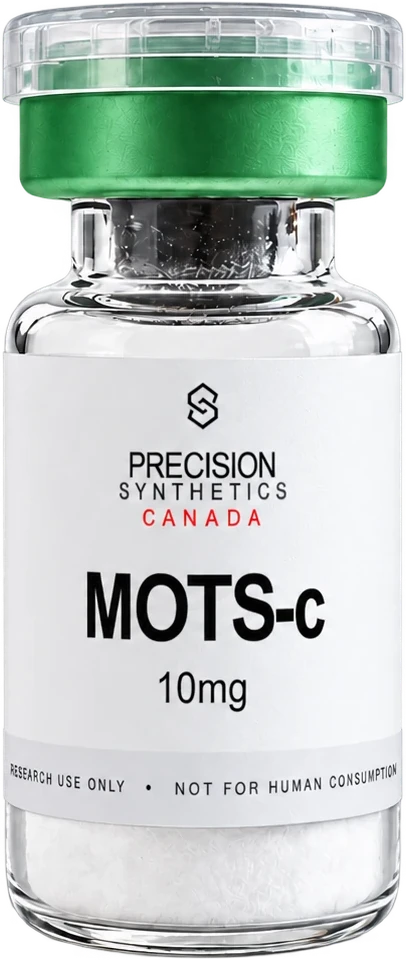
A milligram result for the tested vial, read against the 10 mg on the label.
Endotoxin
The LAL test measures bacterial endotoxin, a contaminant that can skew cell-based experiments.
| Form | Formula | Molecular weight | MOTS-c share of weight |
|---|---|---|---|
| Free peptide | C101H152N28O22S2 | 2174.6 g/mol | 100% |
| Triacetate salt | C107H164N28O28S2 | 2354.8 g/mol | about 92% |
| Tris-TFA salt | C107H155F9N28O28S2 | 2516.7 g/mol | about 86% |
Synthetic peptides are usually isolated with counter-ions attached to their basic residues, most often acetate or trifluoroacetate (TFA). Mass spectrometry still sees the MOTS-c molecule itself, so the identity result is the same for every form. The counter-ions do add weight to the powder, which is why a COA states whether its content figure refers to the peptide alone or to the material as weighed.
When reading a MOTS-c COA, match the batch number on the vial to the report and check that the sample is named as MOTS-c. Our MOTS-c batch is with SideChain Analytics, our primary laboratory, for identity, purity and endotoxin testing. The report will be posted on our COA page and on the MOTS-c product page as soon as results are available, and each report can be verified directly with the issuing lab.
Common MOTS-c Research Questions
What does MOTS-c stand for?
Mitochondrial open reading frame of the 12S rRNA type-c. The name describes where its coding sequence sits, inside the mitochondrial 12S ribosomal RNA gene (MT-RNR1). It is also written MOTS-C or MOTSc, and the 16-residue sequence and CAS number 1627580-64-6 confirm that two listings describe the same compound.
How is MOTS-c related to humanin?
Both are mitochondrial-derived peptides, short peptides encoded by small reading frames in mitochondrial DNA. Humanin and the SHLPs come from the 16S rRNA gene, while MOTS-c comes from the 12S rRNA gene. Their sequences are unrelated, and each has its own research literature.
Has MOTS-c been studied in people?
Yes, but only in one way so far. Published human studies of MOTS-c are observational: they measure the body's own MOTS-c in blood or muscle, for example across groups of people or before and after exercise. The experiments that add MOTS-c to a model have used cell cultures and mice.
Why is MOTS-c called "exercise-induced"?
The phrase comes from the title of Reynolds et al. (2021). In that study, MOTS-c measured in people's skeletal muscle and blood was higher after a bout of exercise than before. It describes the body's own levels rising with exercise. It is not a finding about adding MOTS-c.
Why do listings show different molecular weights for MOTS-c?
The free peptide weighs about 2174.6 g/mol. Acetate and TFA salts carry counter-ions that raise the figure to roughly 2355 and 2517 g/mol, and some listings simply print an incorrect formula. Comparing the sequence and CAS number is the reliable check, and the batch COA states which form was tested.
Is MOTS-c approved by Health Canada?
No. MOTS-c is not approved by Health Canada for therapeutic use; it is a research compound studied in laboratory and preclinical work. Material listed on this site is supplied for qualified laboratory and analytical research.
How should unopened vials be stored?
Keep the vial sealed, dry, protected from light and within any conditions stated in its batch documentation. The handling and storage guide covers this in more detail.
When will the MOTS-c test results be available?
Results are posted on our COA page and the MOTS-c product page as soon as SideChain Analytics completes testing on the batch, and ordering opens at the same time.
Glossary of Terms
Mitochondria
Structures inside cells that produce most of the cell's chemical energy and carry their own small genome.
Mitochondrial DNA (mtDNA)
The circular genome inside mitochondria, 16,569 base pairs in humans, separate from the DNA in the nucleus.
Open reading frame
A stretch of DNA that runs from a start codon to a stop codon and can be translated into a peptide or protein.
Ribosomal RNA (rRNA)
RNA that forms part of the ribosome, the machinery that builds proteins. The 12S and 16S rRNAs belong to mitochondrial ribosomes.
Mitochondrial-derived peptide
A short peptide encoded by a small reading frame in mitochondrial DNA, such as MOTS-c, humanin and the SHLPs.
AMPK
AMP-activated protein kinase, an enzyme that responds to a cell's energy status and is widely measured in metabolic studies.
Folate cycle
A set of reactions that pass one-carbon units between molecules and supply building blocks for making purines, part of DNA and RNA.
NRF2
A transcription factor that switches on a group of antioxidant-response genes in the nucleus.
Counter-ion
A charged molecule, such as acetate or trifluoroacetate, paired with a peptide's charged groups in its salt form.
Lyophilized
Freeze-dried. The peptide is supplied as a dry powder rather than a liquid.
Mass spectrometry
A method that measures molecular mass very precisely, used to confirm a peptide's identity.
HPLC and LAL
HPLC (high-performance liquid chromatography) separates a sample to measure purity. The LAL test detects bacterial endotoxin.
References
- Lee C et al. (2015). The mitochondrial-derived peptide MOTS-c promotes metabolic homeostasis and reduces obesity and insulin resistance. Cell Metabolism 21(3):443–454. PubMed 25738459
- Kim KH et al. (2018). The mitochondrial-encoded peptide MOTS-c translocates to the nucleus to regulate nuclear gene expression in response to metabolic stress. Cell Metabolism 28(3):516–524. PubMed 29983246
- Cataldo LR et al. (2018). Plasma MOTS-c levels are associated with insulin sensitivity in lean but not in obese individuals. Journal of Investigative Medicine 66(6):1019–1022. PubMed 29593067
- Reynolds JC et al. (2021). MOTS-c is an exercise-induced mitochondrial-encoded regulator of age-dependent physical decline and muscle homeostasis. Nature Communications 12:470. PubMed 33473109
- Zempo H et al. (2021). A pro-diabetogenic mtDNA polymorphism in the mitochondrial-derived peptide, MOTS-c. Aging 13(2):1692–1717. PubMed 33468709
- Mohtashami Z et al. (2022). MOTS-c, the most recent mitochondrial derived peptide in human aging and age-related diseases. International Journal of Molecular Sciences 23(19):11991. PubMed 36233287
- Zheng Y, Wei Z, Wang T (2023). MOTS-c: a promising mitochondrial-derived peptide for therapeutic exploitation. Frontiers in Endocrinology 14:1120533. PubMed 36761202
Related Research
For research use only. Not for human or veterinary use.