
ARA-290 (Cibinetide): EPO's Repair Signal, Without the Red Blood Cells
Last updated: October 2026
Erythropoietin, or EPO, is famous for one job: telling the body to make red blood cells. Researchers found it has a second, quieter job, protecting tissue under stress, and that the two jobs run through different receptors. ARA-290 is an 11-amino-acid peptide built to reach only the second one. Here is how it was designed, what twenty years of papers have found, and how an ARA-290 batch is tested.
A Peptide Designed From EPO's Shape
ARA-290 wasn't found in nature. It was sculpted from the surface of a much bigger protein.
EPO is a hormone of 165 amino acids. When it pairs two copies of its receptor on bone-marrow cells, the result is more red blood cells. But other tissues, including nerves, heart and kidney, also respond to EPO in a different way. In the early 2000s, a team led by Michael Brines and Anthony Cerami found evidence that this second response runs through a different receptor: EPO's usual receptor partnered with a protein called CD131, the beta common receptor. They proposed the pairing as a tissue-protective receptor, later called the innate repair receptor.
That raised an obvious question: could you trigger the repair receptor without the red-blood-cell one? The team studied EPO's 3D structure and focused on helix B, a stretch that faces outward when EPO sits on its classic receptor. From the amino acids on helix B's exposed face, they designed a short peptide of just 11 residues.
That peptide became ARA-290, now also known by its international name, cibinetide. It is modelled on EPO's surface, not cut out of it: the 11 residues follow the shape of the helix rather than one continuous stretch of the EPO sequence. Research-grade ARA-290 is made by chemical synthesis and supplied as a freeze-dried powder.
- 11 amino acids
pE-EQLERALNSS - Designed, not discoveredModelled on the surface of EPO's helix B
- Peptide first described in 2008Brines et al., PNAS
- Also calledCibinetide, pHBSP, ARA 290
- CAS 1208243-50-8Free peptide, about 1257.3 g/mol
Why Researchers Pay Attention to ARA-290
Three findings explain why ARA-290 keeps coming up in tissue-repair research. Each one comes from a published paper.
EPO has a second receptor
EPO's red-blood-cell job runs through two copies of its own receptor. Its protective effects on tissue need a different pairing: EPO's receptor plus CD131. In mice lacking CD131, EPO's protective effects in heart and spinal-cord injury models disappeared.
Brines et al., 2004
The two jobs can be separated
An 11-amino-acid peptide modelled on EPO's outer surface protected tissue in rodent models, yet in the same paper neither it nor the larger helix B piece made red blood cells, in cells or in animals.
Brines et al., 2008
Small nerves you can measure
Later studies used corneal confocal microscopy, a way of photographing tiny nerve fibres in the front of the eye, as a measurable marker. That gave researchers a window into small-nerve biology that pain questionnaires alone can't provide.
Dahan et al., 2013 · Culver et al., 2017
Two Receptors, Two Jobs
The whole idea behind ARA-290 comes down to which receptor gets the signal.
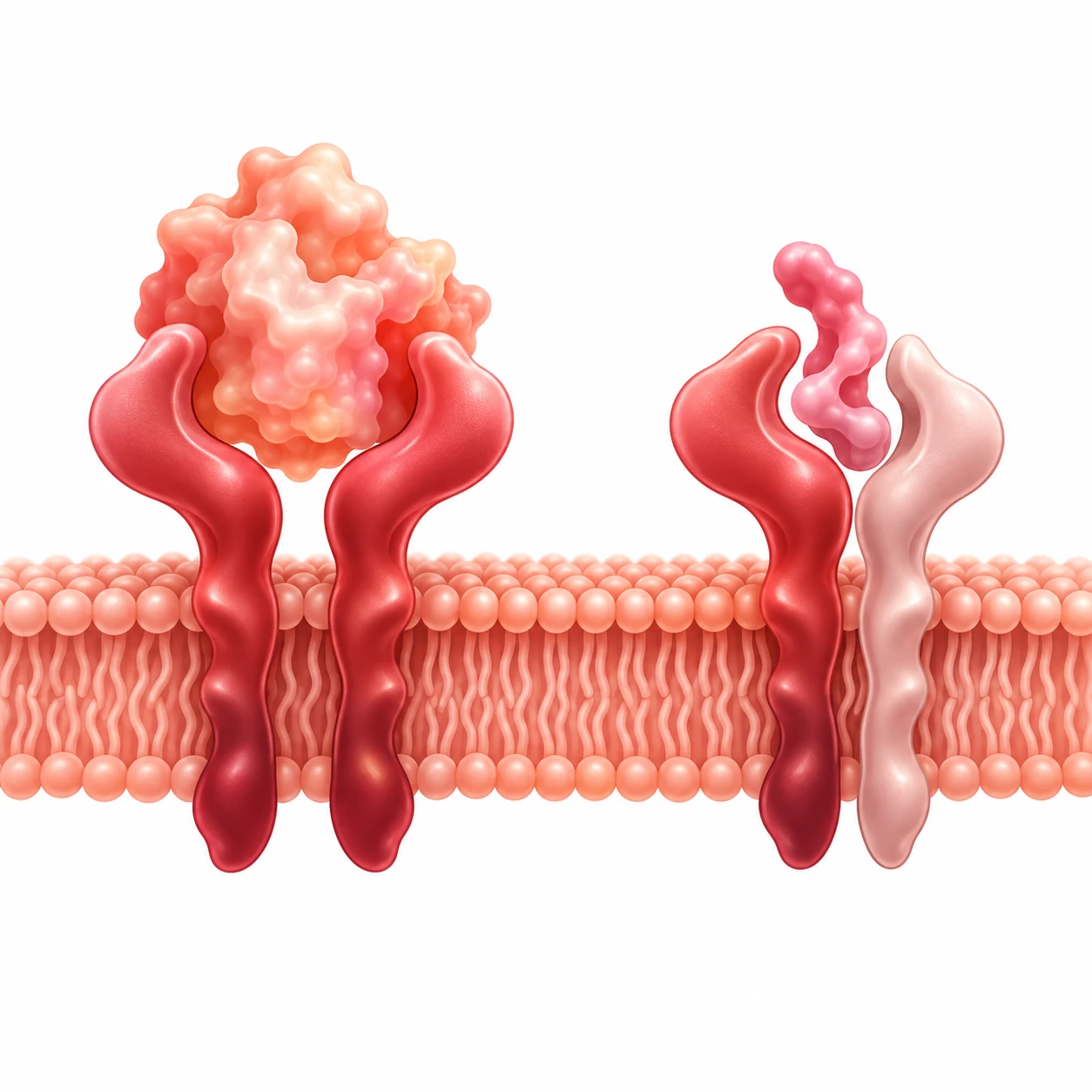
Schematic, not to scale. EPO is roughly 24 times heavier than ARA-290.
The classic receptor and the repair receptor
EPO can switch on two different receptor pairs. ARA-290 was designed to reach only one of them.
The 11 Amino Acids of ARA-290
This is the whole peptide, start to finish. Hover over or tap any amino acid to see what it is, and look at position 1: it's a ring, not a regular start.
Two acidic glutamates and a free acid at the end, against a single arginine, give ARA-290 an overall negative charge at neutral pH, the opposite of SS-31.
| Sequence | pGlu-Glu-Gln-Leu-Glu-Arg-Ala-Leu-Asn-Ser-Ser-OH (pE-EQLERALNSS) |
|---|---|
| Molecular formula | C51H84N16O21 (free peptide) |
| Molecular weight | About 1257.3 g/mol (free peptide) |
| Monoisotopic mass | 1256.5997 Da |
| CAS number | 1208243-50-8 |
| PubChem CID | 91810664 |
| Other names | Cibinetide, ARA 290, ARA290, pHBSP (pyroglutamate helix B surface peptide) |
Twenty Years of ARA-290 Research
From a second receptor to small nerves in the eye, here's how the story unfolded, one chapter at a time. Keep scrolling.
- 2004
EPO's second receptor
Brines et al., PNAS · rat organ membranes, cell lines and knockout mice
This is where it starts. EPO was already known to protect tissue in injury models, but versions that couldn't bind the classic receptor still worked. So what was EPO talking to? Pulling membrane proteins from rat brain, heart, liver and kidney, the team found the EPO receptor bound in a complex with CD131. The two sat together on protected nerve and heart cells. And in mice lacking CD131, EPO's protective effect in heart-cell and spinal-cord injury models disappeared.
- 2008
Shrinking EPO to 11 amino acids
Brines et al., PNAS · cell culture, rats and mice
Next, the team hunted for the smallest piece of EPO that still carried the protective signal. Helix B protected nerve cells in culture and tissue in rodent models of stroke, diabetic retinal swelling and nerve injury. Then they went smaller: an 11-amino-acid peptide built from helix B's outward face protected tissue in stroke and kidney blood-flow models, sped up wound healing and improved performance on cognitive tasks in rodents. Neither helix B nor the 11-mer made red blood cells, in cells or in animals.
- 2012
A first small trial
Heij et al., Molecular Medicine · pilot randomized trial, 22 participants
ARA-290 moved into people as an investigational medicine. This double-blind, placebo-controlled pilot enrolled 22 adults with sarcoidosis, an inflammatory disease, who had symptoms of small-fibre neuropathy, for four weeks. Clinical and laboratory checks raised no concerns. The ARA-290 group improved more than placebo on a small-fibre neuropathy symptom checklist, and showed significant gains in the pain and physical-functioning parts of a quality-of-life survey. Average pain scores and fatigue improved too, but equally in both groups, and mood scores didn't change.
- 2013
Looking at nerves in the eye
Dahan et al., Molecular Medicine · placebo-controlled trial in sarcoidosis
The next trial added something you can see. Over 28 days, people with sarcoidosis-related small-nerve-fibre loss received ARA-290 or placebo. The ARA-290 group reported significantly improved neuropathy symptoms, and the researchers also saw a significant increase in small nerve-fibre density in the cornea, changes in skin temperature sensitivity, and a longer six-minute walk. Seeing nerve fibres change, not just how people felt, made this paper a turning point for the program.
- 2014
Back in the lab: nerve injury in rats
Swartjes et al., Molecular Pain · rat spared-nerve-injury model
A Leiden team returned to animals to understand the biology. After a standard nerve injury in rats, ARA-290 given over the first ten days reduced pain-like sensitivity to touch and cold for up to 20 weeks compared with untreated animals, more so at higher amounts. In the spinal cord it held back the activation of microglia, the immune cells of the nervous system, while astrocytes were unchanged, pointing to inflammation as part of the story.
- 2015
A trial in type 2 diabetes
Brines et al., Molecular Medicine · phase 2 trial in type 2 diabetes with neuropathy
The program widened to people with type 2 diabetes and painful neuropathy: 28 days of ARA-290 or placebo, then a month of follow-up. Over the 56 days, the ARA-290 group showed improved blood-sugar control (HbA1c) and blood lipids, and significantly improved neuropathy symptoms on a standard questionnaire. Among participants whose corneal nerve-fibre density started well below normal, fibre density rose with ARA-290 while the placebo group's didn't change. The authors called for further clinical evaluation.
- 2017
Nerve imaging as the main measure
Culver et al., Investigative Ophthalmology & Visual Science · phase 2b trial, 64 participants
The largest of the trials described here, now under the name cibinetide: 64 people with sarcoidosis-related small-nerve loss, three dose groups and placebo, 28 days. The main measure, corneal nerve-fibre area, rose significantly in one of the three dose groups, which also showed more regenerating nerve fibres in skin biopsies. Across participants, nerve gains tracked with better six-minute walk results. Pain improved in every group, placebo included, so the difference in pain wasn't statistically significant. The authors read the nerve findings as consistent with a disease-modifying effect.
So where does that leave us? ARA-290 is one of the clearest examples of a molecule designed from a protein's shape to separate one of its jobs from another. Its preclinical work spans cells, rats and mice. In people, a handful of small, short trials of an investigational medicine reported improvements in neuropathy symptoms and in small nerve fibres you can photograph, alongside measures where placebo did just as well. None of that makes it an approved treatment, and each paper speaks for its own population and conditions, so the references below link every original.
Where ARA-290 Research Is Heading
The most interesting questions about ARA-290 are still open. These are the ones researchers keep coming back to.
Where is the repair receptor, and when?
The EPO receptor and CD131 pairing was shown on nerve and heart cells under injury. Which tissues assemble it, and what stress switches it on, are still being mapped.
Brines et al., 2004
How much of EPO can be separated?
ARA-290 showed that a protein's surface can be mined for one function at a time. The same design idea, building small peptides from a large protein's exposed faces, is a tool for studying other signalling proteins too.
Brines et al., 2008
What links repair and inflammation?
In the rat nerve-injury model, the effects came with quieter microglia in the spinal cord. How the repair receptor connects to immune cells in the nervous system is one of the field's central open questions.
Swartjes et al., 2014
Better ways to measure small nerves
Corneal confocal microscopy turned an invisible problem into something countable. Whether imaging markers like this can stand in for slower clinical outcomes is a question that reaches well beyond ARA-290.
Dahan et al., 2013 · Culver et al., 2017
In the clinic, separately. ClinicalTrials.gov lists a handful of small phase 1 and 2 studies of ARA-290 as an investigational medicine, in sarcoidosis-related nerve-fibre loss, type 2 diabetes, depression and diabetic macular oedema (one of them terminated). No cibinetide product is approved in Canada; Health Canada's Drug Product Database lists none. The ARA-290 supplied here is a research-grade peptide for laboratory study.
EPO vs ARA-290: The Hormone and the Peptide
They share a shape, not a size. ARA-290 keeps a sliver of EPO's surface and leaves the rest behind.
| ARA-290 | EPO | |
|---|---|---|
| What it is | Synthetic peptide modelled on EPO's helix B | Natural glycoprotein hormone |
| Length | 11 amino acids | 165 amino acids |
| Receptor studied | Repair receptor (EPO receptor + CD131) | Classic EPO receptor pair and the repair receptor |
| Red-blood-cell production | Not seen in the 2008 cell and animal tests | Its main hormonal job |
| Start of the chain | Pyroglutamate ring | Standard amino acid |
| Molecular weight | About 1257 g/mol | About 30,000 g/mol with its sugar chains |
Reading an ARA-290 COA
A research guide is only as good as the material on the bench. A certificate of analysis answers four questions about an ARA-290 batch.
Identity
Mass spectrometry measures the molecule's mass. An ARA-290 result should sit close to 1256.6 Da (monoisotopic) or 1257.3 Da (average) for the peptide itself.
Purity
HPLC separates the sample and reports what share of the peptide signal is ARA-290 rather than shorter or modified synthesis by-products.
Content
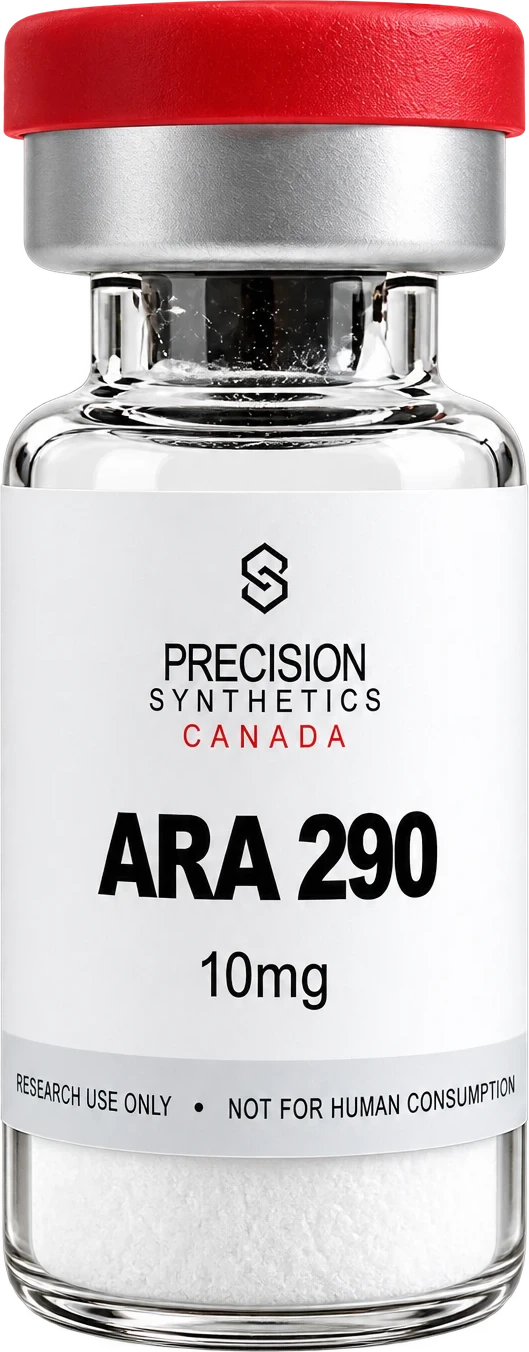
A milligram result for the tested vial, read against the 10 mg on the label.
Endotoxin
The LAL test measures bacterial endotoxin, a contaminant that can skew cell-based experiments.
What's actually in a 10 mg vial?
Synthetic peptides usually come out of purification with small charged partners, called counter-ions, attached to their charged groups. They add weight to the powder but no peptide, so the milligrams of powder and the milligrams of ARA-290 itself can differ.
The identity test isn't affected: mass spectrometry reads the ARA-290 molecule itself. Where it matters is the content line. A good COA says whether its milligram figure means the peptide itself (net peptide content) or the powder as weighed, so you know exactly what you're working with.
When reading an ARA-290 COA, match the batch number on the vial to the report and check that the sample is named as ARA-290 or cibinetide. SideChain Analytics, our primary laboratory, is testing our ARA-290 batch, including endotoxin. The report will be posted on our COA page and on the ARA-290 product page as soon as results are available, and each report can be verified directly with the issuing lab.
Common ARA-290 Research Questions
What is ARA-290?
ARA-290, also called cibinetide, is an 11-amino-acid synthetic peptide modelled on the outer surface of erythropoietin (EPO). It was designed to activate the proposed tissue-protective "repair receptor" without stimulating red-blood-cell production, and it has been studied in cells, animals and small clinical trials.
Is ARA-290 the same as cibinetide?
Yes. Cibinetide is the international nonproprietary name for ARA-290, and pHBSP (pyroglutamate helix B surface peptide) is the descriptive name used in many papers. The sequence pE-EQLERALNSS and CAS number 1208243-50-8 confirm that two listings describe the same compound.
Is ARA-290 a piece of EPO?
Not exactly. It is modelled on the outward-facing residues of EPO's helix B, so it mimics part of EPO's surface shape. The 11 residues are not one continuous stretch cut from the EPO sequence.
Does ARA-290 make red blood cells?
In the 2008 paper that introduced the peptide, neither the 11-amino-acid peptide nor the larger helix B piece stimulated red-blood-cell production in cell or animal tests. That separation is the reason it was designed.
What is the innate repair receptor?
A pairing of the EPO receptor with CD131, the beta common receptor, first proposed as a tissue-protective receptor in 2004; how and where it forms is still being studied. It is distinct from the two-receptor pairing EPO uses to drive red-blood-cell production.
Why does ARA-290 start with pyroglutamate?
Pyroglutamate is a glutamine or glutamate whose side chain has closed into a ring with its own amino group. It caps the start of the peptide, so ARA-290 has no free N-terminal amine. It is written as "pGlu" or "pE".
Has ARA-290 been studied in people?
Yes, as an investigational medicine in small, short clinical trials, including studies in sarcoidosis-related small-nerve-fibre loss and type 2 diabetes. Research-grade ARA-290 supplied for laboratory study is a different thing from an investigational drug product used in a regulated trial.
Is ARA-290 approved by Health Canada?
No. Health Canada's Drug Product Database lists no cibinetide or ARA-290 product. It is a research compound studied in laboratory, preclinical and early clinical work, and the material offered here is supplied for laboratory and analytical research.
How should unopened vials be stored?
Keep the vial sealed, dry, protected from light and within any conditions stated in its batch documentation. The handling and storage guide covers this in more detail.
When will the ARA-290 test results be available?
Results are posted on our COA page and the ARA-290 product page as soon as SideChain Analytics completes testing on the batch, and ordering opens at the same time.
Glossary of Terms
Erythropoietin (EPO)
A 165-amino-acid hormone, made mainly in the kidney, best known for driving red-blood-cell production.
Helix B
One of the four helices that make up EPO's structure. ARA-290 is modelled on its outward-facing side.
CD131 (beta common receptor)
A receptor subunit shared by several cytokine receptors. Paired with the EPO receptor, it forms the repair receptor.
Innate repair receptor
The EPO receptor and CD131 pairing linked to tissue protection in preclinical studies.
Erythropoietic
Stimulating red-blood-cell production.
Pyroglutamate (pGlu)
A ring-closed form of glutamine or glutamate that caps the start of a peptide.
Sarcoidosis
An inflammatory disease that can affect many organs, sometimes including small nerve fibres.
Small-fibre neuropathy
Damage to the thinnest nerve fibres, which carry temperature and pain signals and control automatic functions.
Corneal confocal microscopy
A non-invasive imaging method that photographs tiny nerve fibres in the cornea at the front of the eye.
Microglia
The resident immune cells of the brain and spinal cord.
Mass spectrometry
A method that measures molecular mass very precisely, used to confirm a peptide's identity.
HPLC and LAL
HPLC (high-performance liquid chromatography) separates a sample to measure purity. The LAL test detects bacterial endotoxin.
References
- Brines M et al. (2004). Erythropoietin mediates tissue protection through an erythropoietin and common beta-subunit heteroreceptor. PNAS 101(41):14907–14912. PubMed 15456912
- Brines M et al. (2008). Nonerythropoietic, tissue-protective peptides derived from the tertiary structure of erythropoietin. PNAS 105(31):10925–10930. PubMed 18676614
- Heij L et al. (2012). Safety and efficacy of ARA 290 in sarcoidosis patients with symptoms of small fiber neuropathy: a randomized, double-blind pilot study. Molecular Medicine 18(1):1430–1436. PubMed 23168581
- Dahan A et al. (2013). ARA 290 improves symptoms in patients with sarcoidosis-associated small nerve fiber loss and increases corneal nerve fiber density. Molecular Medicine 19(1):334–345. PubMed 24136731
- Swartjes M et al. (2014). ARA 290, a peptide derived from the tertiary structure of erythropoietin, produces long-term relief of neuropathic pain coupled with suppression of the spinal microglia response. Molecular Pain 10:13. PubMed 24529189
- Brines M et al. (2015). ARA 290, a nonerythropoietic peptide engineered from erythropoietin, improves metabolic control and neuropathic symptoms in patients with type 2 diabetes. Molecular Medicine 20(1):658–666. PubMed 25387363
- Culver DA et al. (2017). Cibinetide improves corneal nerve fiber abundance in patients with sarcoidosis-associated small nerve fiber loss and neuropathic pain. Investigative Ophthalmology & Visual Science 58(6):BIO52–BIO60. PubMed 28475703
Related Research
For research use only. Not for human or veterinary use.