
Research dossier
TB-500: The Motility Map
Reviewed July 12, 2026TB-500 commonly refers to Ac-LKKTETQ-OH, a synthetic seven-residue fragment of full-length thymosin beta-4. It is promoted online for healing and recovery, although direct research mainly concerns identity, detection, metabolism, and one cell assay.7, 8, 9, 10 FDA's May 2026 review identified no studies administering TB-500 free base or acetate to humans.11
Research orientation
What TB-500 is and why researchers study it
TB-500 is commonly used as a name for Ac-LKKTETQ-OH. It is a synthetic, N-terminally acetylated seven-residue peptide corresponding to residues 17-23 of full-length thymosin beta-4.7, 11
The sequence comes from a region involved in actin binding within the full-length parent peptide. Actin helps cells maintain shape and move, which explains the interest in migration and repair models. The direct mechanism and recovery effects of Ac-LKKTETQ remain unresolved.1, 11
What it isTB-500 commonly refers to Ac-LKKTETQ-OH, a synthetic seven-residue peptide carrying an acetyl group at its N-terminus. Its sequence corresponds to residues 17-23 of full-length thymosin beta-4.7, 11
Where the mechanism comes fromFull-length thymosin beta-4 binds G-actin and helps regulate the actin monomer pool. Ac-LKKTETQ contains sequence from that binding region, while its own direct G-actin-sequestering activity remains unestablished.1, 11
How it is promotedOnline sellers promote TB-500 for muscle, tendon, ligament, wound, and inflammatory recovery. These claims extend beyond the direct evidence available for Ac-LKKTETQ.11, 13
What direct research existsDirect studies mainly cover chemical identity, detection, pharmacokinetics, metabolism, and one fibroblast scratch assay. FDA's May 2026 review identified no studies administering TB-500 free base or acetate to humans.7, 8, 9, 10, 11
Material key
Five materials that appear in the TB-500 evidence record
The same short sequence appears in several chemical forms and inside a larger parent peptide. The study result belongs to the exact material the researchers tested.7, 11
Full-length thymosin beta-4
A 43-residue peptide with established G-actin-binding biology. Many migration, blood-vessel, wound, and human studies in the broader literature examine this parent peptide.1, 2, 3, 4, 5, 6
Non-acetylated LKKTETQ
A seven-residue sequence used in some early endothelial and aged-mouse skin-wound experiments. Its findings cannot be directly transferred to N-terminally acetylated TB-500.4, 11
Ac-LKKTETQ-OH / TB-500 free base
The N-terminally acetylated seven-residue material commonly called TB-500. Direct research mainly concerns identity, detection, disposition, metabolism, and one cell assay.7, 8, 9, 10, 11
TB-500 acetate
The acetate salt of Ac-LKKTETQ. FDA treats it as a distinct bulk drug substance because salt form can affect physical, pharmacokinetic, safety, and efficacy properties.11
Truncated metabolites
Shorter peptides formed as TB-500 is broken down. Ac-LKKTE produced a small increase in scratch closure in one 2024 cell experiment where the parent peptide did not.8, 9, 10
Evidence overview
What the evidence record contains
The literature includes chemical identification, general cell biology, experiments with related peptide materials, direct TB-500 disposition and assay work, and the unanswered question of human outcomes.
-
01
Material identity
Ac-LKKTETQ-OH is chemically distinct from full-length thymosin beta-4, non-acetylated LKKTETQ, its acetate salt, and truncated metabolites.7, 11
-
02
General cell biology
Actin organization, leading-edge formation, and cell migration explain how cells move. These processes occur independently of any particular TB-500 claim.1, 2, 3
-
03
Related peptide studies
Positive migration, sprouting, and animal repair findings often involve full-length thymosin beta-4 or non-acetylated and otherwise unspecified fragments.2, 3, 4, 5, 6
-
04
Direct TB-500 studies
The direct record focuses on identity and metabolism. In a 2024 scratch assay, parent TB-500 did not significantly increase closure at the tested condition.7, 8, 9, 10
-
05
Evidence in people
FDA's May 2026 review identified no human administration, efficacy, pharmacokinetic, pharmacodynamic, or clinical-safety studies for the reviewed TB-500 forms.11
How to read the visual sequence: the five research lenses combine ordinary actin biology with findings from separate studies of full-length thymosin beta-4, non-acetylated LKKTETQ, Ac-LKKTETQ, and other experimental systems. No cited experiment followed TB-500 through all five lenses as one treatment response.
Mechanistic framework
Cell-movement biology in TB-500 research
These research lenses move from actin organization to cell migration and early blood-vessel models, then separate direct TB-500 studies from findings involving related materials. They provide cross-study orientation rather than a demonstrated treatment sequence.
Cross-study research lensesThe sequence combines ordinary cell biology with separate studies of several peptide materials. No cited experiment follows Ac-LKKTETQ/TB-500 through all five lenses as one treatment response.
Research lens 01 / 05
Actin monomer pool
Cells need a movable internal scaffold. Full-length thymosin beta-4 binds G-actin. Ac-LKKTETQ contains sequence from that region, while direct G-actin sequestration by the short acetylated peptide has not been established.1, 11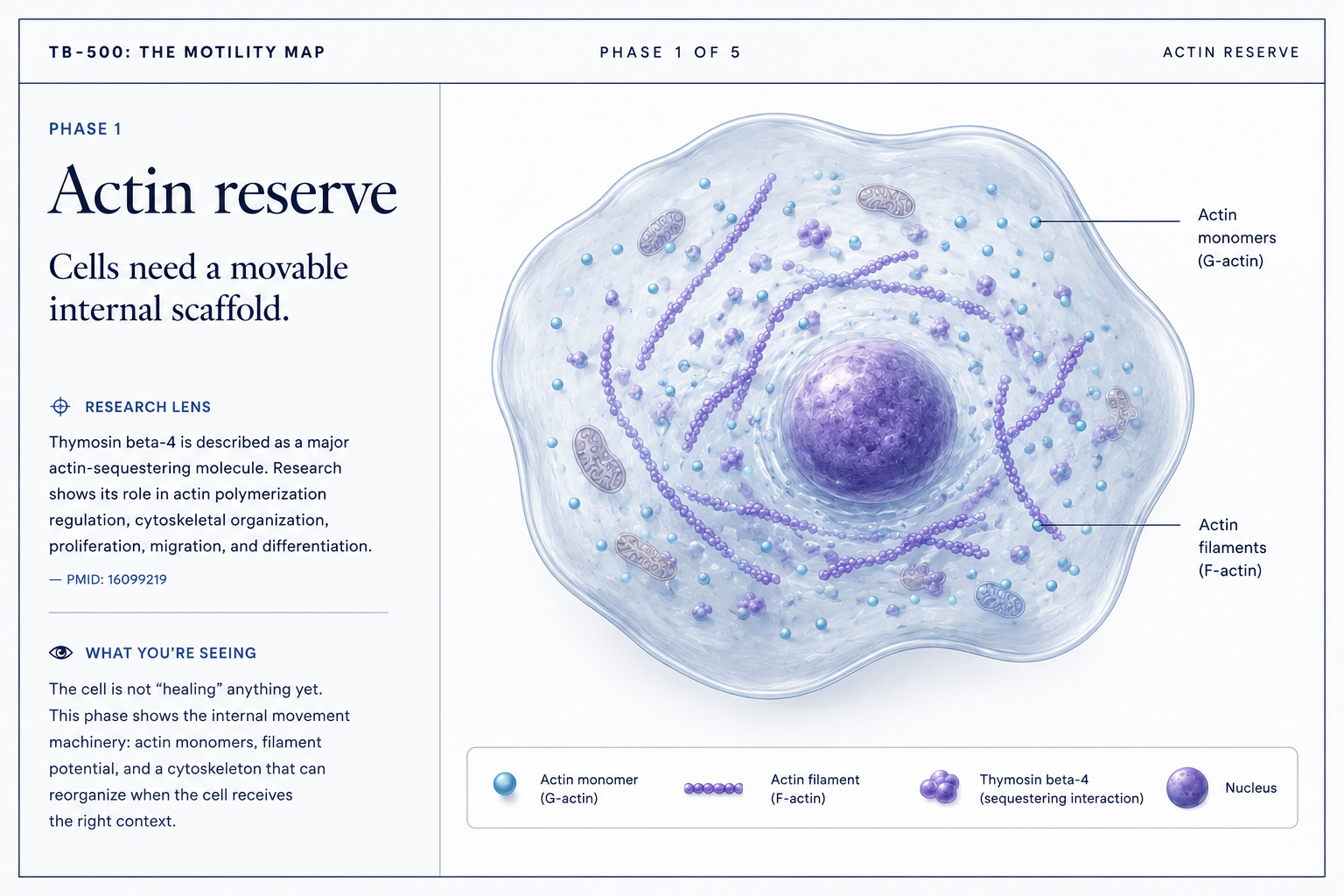
Key interpretation
Cells maintain a pool of separate G-actin units that can be assembled into F-actin as shape and movement change. Full-length thymosin beta-4 helps regulate this pool. The short Ac-LKKTETQ peptide contains part of the relevant sequence, although its own G-actin-buffering activity remains unresolved.1, 11
Research lens 02 / 05
Leading edge
Movement starts when the cell forms a front. Leading-edge formation is ordinary cell-migration biology. Full-length thymosin beta-4 has been studied in endothelial migration models, without establishing the same response for Ac-LKKTETQ.2, 11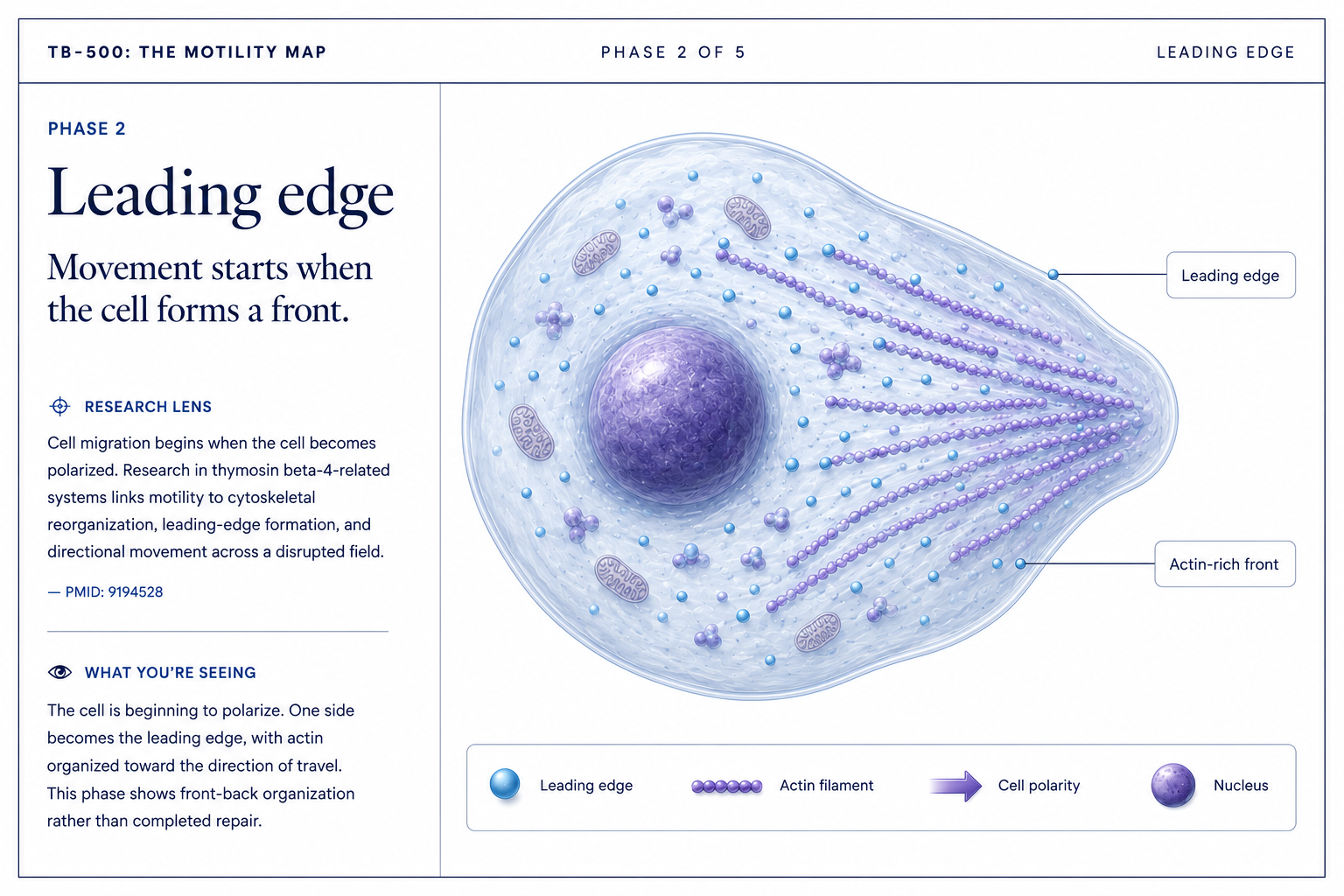
Key interpretation
A migrating cell organizes into a front and a rear. Actin assembly near the leading edge helps the membrane extend in the direction of travel. Research with full-length thymosin beta-4 provides related migration context, while the direct response of Ac-LKKTETQ remains a separate question.2, 11
Research lens 03 / 05
Migration path
Cells cross the disrupted field. Scratch assays measure how cultured cells move into an open gap. In a 2024 direct test, parent TB-500 did not significantly increase closure at the tested concentration and time point.10, 11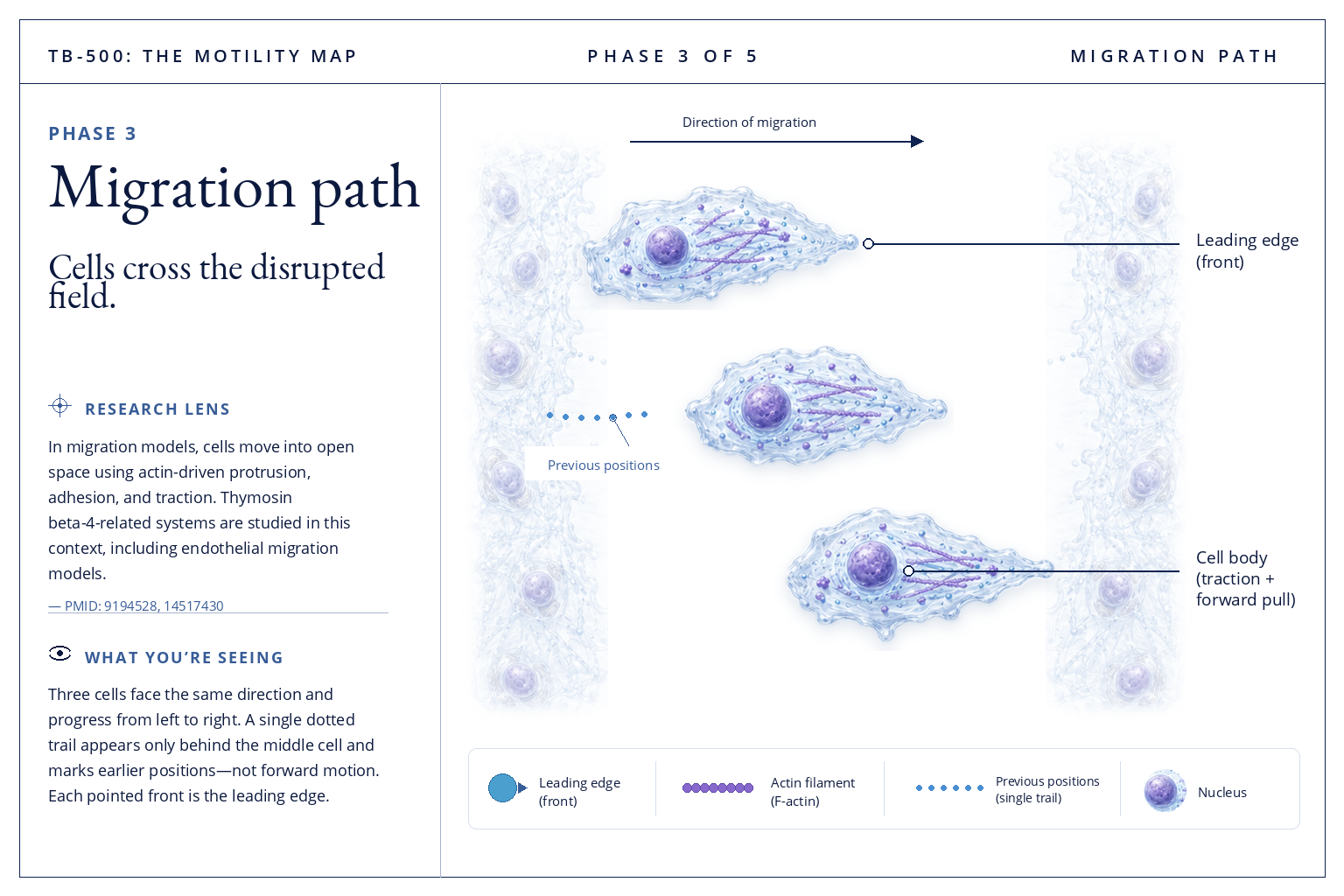
Key interpretation
In a scratch assay, researchers create a gap in a cultured cell layer and compare how much of the gap closes. Rahaman and colleagues tested TB-500 free base at 50 micrograms per millilitre for eight hours and found no significant increase relative to vehicle. Ac-LKKTE, a truncated metabolite, produced a small increase under the same conditions.10, 11
Research lens 04 / 05
Endothelial sprout
Blood-vessel cells extend and form branches. Endothelial migration, tube formation, and sprouting were reported with full-length thymosin beta-4 or a synthetic actin-region peptide whose terminal chemistry should be kept distinct from TB-500.2, 3, 5, 11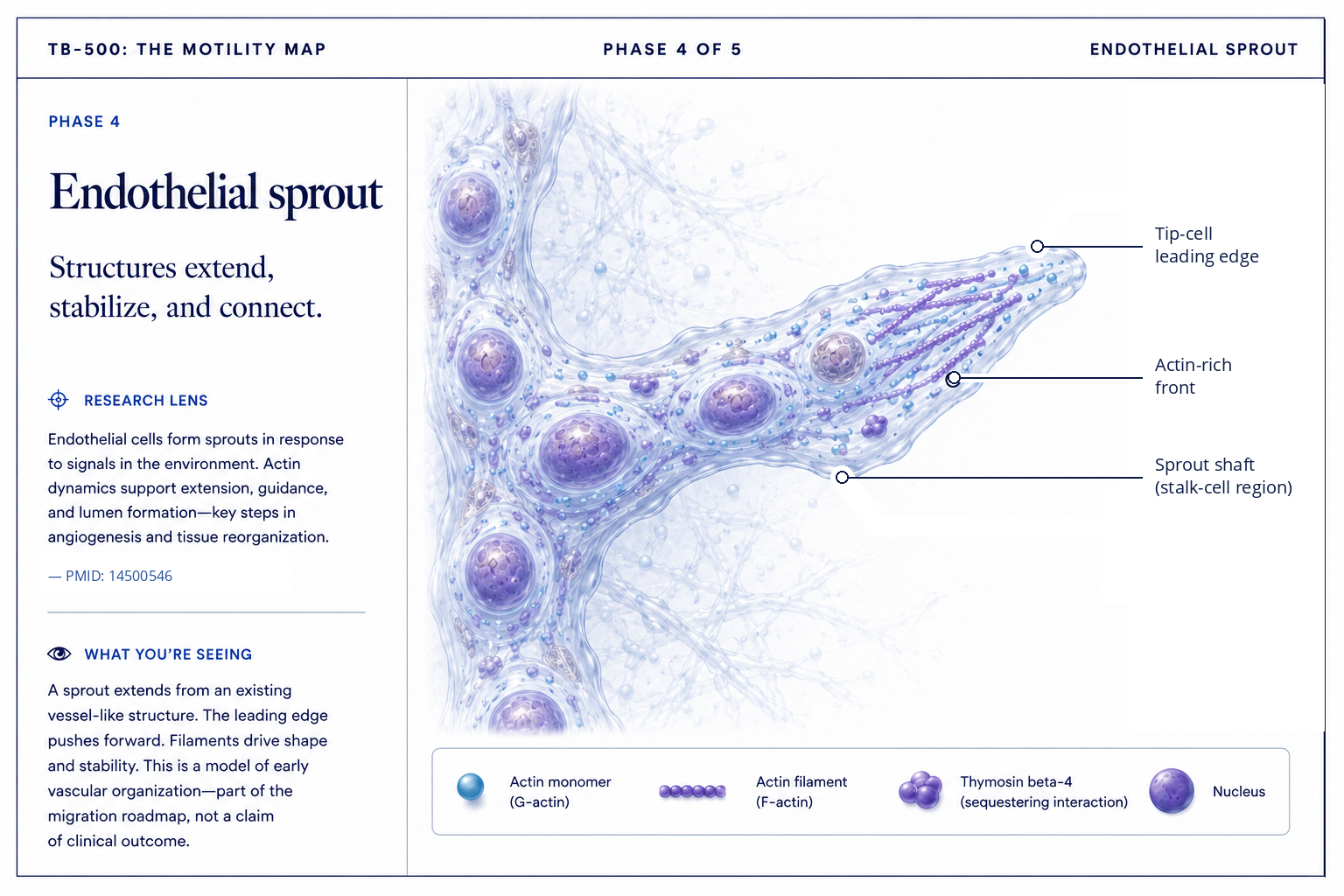
Key interpretation
Endothelial cells line blood vessels and can organize into tubes or sprouts in experimental systems. The cited findings come from full-length thymosin beta-4 and a synthetic actin-region peptide studied in cell culture or isolated tissue. They describe early vascular organization in those models and do not establish a blood-vessel effect from TB-500 in people.2, 3, 5, 11
Six research lenses separate direct studies of Ac-LKKTETQ or TB-500 from studies of full-length thymosin beta-4, non-acetylated LKKTETQ, and general cell biology. The sequence is a cross-study comparison rather than one demonstrated treatment response.
RESEARCH LENS 5
Evidence map
Most cited findings are indirect and preclinical, with direct TB-500 repair evidence remaining sparse.
MATERIAL-SPECIFIC RECORD
Direct Ac-LKKTETQ studies mainly cover identity, detection, metabolism, and one fibroblast scratch assay. The better-known migration, blood-vessel, and animal repair findings often used in TB-500 discussions come from full-length thymosin beta-4 or differently modified peptide material.2, 3, 4, 5, 7, 8, 9, 10
EVIDENCE LEVELS
MATERIAL, MODEL, FINDING
-
Ac-LKKTETQ / TB-500 identity N-terminally acetylated residues 17-23 were identified in material sold as TB-500. Esposito 20127 IDENTITY
-
Direct TB-500 disposition studies Horse exposure and rat or in-vitro metabolism studies measured the parent peptide and truncated metabolites. Ho 20128, Zvereva 20169, Rahaman 202410 PK / METABOLISM
-
Direct fibroblast scratch assay Parent TB-500 did not significantly increase closure at the tested condition; Ac-LKKTE produced a small increase. Rahaman 202410 CELL ASSAY
-
Related peptide cell models Migration, tube formation, and sprouting findings mainly concern full-length thymosin beta-4 or a synthetic actin-region peptide. Malinda 19972, Grant 19993, Philp 20035 RELATED MATERIAL
-
Related peptide animal repair models The cited skin-wound study used full-length thymosin beta-4 or non-acetylated LKKTETQ, rather than TB-500 free base or acetate. Philp 20034 RELATED MATERIAL
-
Human and safety evidence FDA identified no human administration studies for TB-500 free base or acetate, and major toxicology gaps remain. FDA staff review, May 202611 NO HUMAN STUDIES FOUND
FDA IDENTIFIED NO HUMAN ADMINISTRATION STUDIES FOR THE REVIEWED TB-500 FORMS AS OF MAY 202611
- Identity
- Disposition / assay
- Related peptide models
- Human / safety
Key interpretation
Direct Ac-LKKTETQ research is concentrated in analytical identification, detection, pharmacokinetics, metabolism, and one fibroblast assay. FDA's May 2026 review identified no nonclinical in-vivo wound-repair study, human administration study, or clinical-safety study for TB-500 free base or TB-500 acetate.1, 2, 3, 4, 5, 7, 8, 9, 10, 11
Core concepts
Four distinctions that shape the evidence
The research record becomes clearer when ordinary cell biology, related-peptide experiments, direct TB-500 studies, and human evidence are kept in separate groups.
Actin biology comes from the parent peptide
Full-length thymosin beta-4 binds G-actin and helps regulate the actin monomer pool. Ac-LKKTETQ contains part of that binding region, but its direct G-actin-sequestering activity has not been established.1, 11
The direct cell assay produced a mixed result
In one 2024 fibroblast experiment, TB-500 free base did not significantly increase gap closure at the tested condition. The truncated metabolite Ac-LKKTE produced a small increase.10, 11
Positive repair findings involve related materials
Migration, sprouting, and animal skin-wound findings largely come from full-length thymosin beta-4, non-acetylated LKKTETQ, or a synthetic actin-region peptide whose exact terminal chemistry requires separate attribution.2, 3, 4, 5, 11
Human and safety studies remain absent
FDA identified no human administration or clinical-safety studies for the reviewed TB-500 forms. Acute, repeat-dose, genotoxicity, reproductive, developmental, and carcinogenicity studies were also not identified.11
Research map
What researchers are studying
Each row shows the question researchers asked, the laboratory or animal setup they used, the result they reported, and the limits of that result.
| Research question | Study setup | Reported result | Limits |
|---|---|---|---|
| How was TB-500 identified? | Researchers chemically analysed material sold as TB-500. | They identified Ac-LKKTETQ, an N-terminally acetylated seven-amino-acid fragment corresponding to residues 17-23 of thymosin beta-4.7 | The study established the material's chemical identity. It did not test wound repair, recovery, safety, or use in people. |
| What happened after TB-500 was given to horses? | Horses received a single dose of N-acetylated LKKTETQ, and researchers tested blood and urine over time. | The parent peptide and shorter breakdown products were detected, allowing researchers to describe exposure and metabolism after administration.8 | The experiment focused on detection and anti-doping analysis. It did not measure healing or recovery, and horse results cannot establish human outcomes. |
| How was TB-500 broken down in laboratory tests? | Researchers exposed synthetic TB-500 to human serum and liver and kidney test systems outside the body. | They mapped how the peptide was broken into shorter metabolites.9 | These experiments examined metabolism outside the body. They did not measure injury recovery, benefit, or safety in people. |
| Did TB-500 help cultured cells close a scratch? | Cultured fibroblasts were tested in a scratch assay for eight hours at one TB-500 concentration. | Parent TB-500 did not significantly increase scratch closure. A shorter breakdown product called Ac-LKKTE produced a small increase.10 | The experiment used one cell model, one concentration, and one time point. Scratch closure measures cell movement in a dish rather than recovery from an injury. |
| What happened in full-length thymosin beta-4 cell studies? | Researchers studied the 43-residue parent peptide in cultured human endothelial cells. | The studies reported directional migration, cell-matrix attachment, tube formation, and changes in the actin cytoskeleton.2, 3 | Full-length thymosin beta-4 is a different material from the seven-residue Ac-LKKTETQ peptide commonly called TB-500. |
| What happened with the synthetic seven-residue actin-region peptide? | Researchers tested endothelial cells and isolated aortic tissue. | They reported migration, adhesion, tube formation, and sprouting in the experimental systems.5 | The study abstract does not establish that the peptide's terminal chemistry matched Ac-LKKTETQ, the material commonly called TB-500. |
| What happened in animal skin-wound studies? | Researchers studied dermal wounds in diabetic or aged mice and normal rats using full-length thymosin beta-4 or non-acetylated LKKTETQ. | Some material-specific groups showed improved skin-wound endpoints.4, 11 | The studies used animal wounds and peptide materials that differ from N-terminally acetylated TB-500. They do not establish wound-healing outcomes in people. |
| What has been measured in people? | FDA staff reviewed published clinical, exposure, and safety information for TB-500 free base and TB-500 acetate. | The review identified no human administration, efficacy, pharmacokinetic, pharmacodynamic, or clinical-safety studies for those forms.11 | Possible benefits, risks, and exposure in people remain unknown because human administration studies were not identified. |
Evidence timeline
How the research developed
The timeline follows key papers and regulatory updates in date order.
-
1997 Full-length thymosin beta-4 was studied in directional migration of cultured human endothelial cells.2 Malinda et al.
-
1999 Full-length thymosin beta-4 was studied in endothelial attachment, proliferation, tube formation, internalization, and actin-cytoskeleton rearrangement.3 Grant et al.
-
2003 A synthetic seven-residue actin-region peptide was studied in endothelial migration, adhesion, tube formation, and isolated-tissue sprouting. The abstract does not establish that its terminal chemistry matched TB-500.5 Philp et al., angiogenesis study
-
2003 Full-length thymosin beta-4 and non-acetylated LKKTETQ were studied in skin-wound models involving diabetic or aged mice and normal rats.4 Philp et al., wound study
-
2012 Ac-LKKTETQ was chemically identified and characterized in material sold as TB-500.7 Esposito et al.
-
2016 Human serum, liver, and kidney systems studied outside the body were used to map TB-500 metabolism. No human participant received the peptide.9 Zvereva et al.
-
2024 A direct fibroblast scratch assay found no significant increase in closure from parent TB-500 at the tested condition; Ac-LKKTE produced a small increase. Rat experiments in the same report examined metabolism.10 Rahaman et al.
-
2026 FDA staff proposed that TB-500 free base and acetate not be added to the 503A Bulks List. The advisory committee is scheduled to discuss them on July 23, and FDA had issued no final determination as of July 12.11, 12 FDA briefing and meeting page
-
2026 Health Canada listed TB-500 among examples of seized unauthorized injectable peptide drugs. The advisory concerns authorization, quality, and general product risks rather than TB-500-specific clinical events.13 Health Canada advisory
-
2026 WADA's 2026 Prohibited List places thymosin-beta-4 and derivatives such as TB-500 under S2.3, a class prohibited at all times.14 WADA 2026 Prohibited List
Current context
Regulatory and safety record
FDA staff proposed that TB-500 free base and TB-500 acetate not be added to the 503A Bulks List. The advisory committee is scheduled to discuss them on July 23, 2026, and FDA had issued no final determination as of this review date.11, 12
FDA meeting materialsHealth Canada's April 9, 2026 advisory lists TB-500 among examples of seized unauthorized injectable peptide drugs. The advisory addresses authorization, manufacturing quality, and general product risks; it does not report TB-500-specific clinical adverse events.13
Health Canada advisoryFDA identified no human exposure or clinical-safety studies and no acute, repeat-dose, genotoxicity, reproductive, developmental, or carcinogenicity studies for the reviewed forms. It also described potential injectable-peptide concerns involving immune responses, aggregation, and peptide-related impurities.11
FDA staff reviewCommon questions
Common TB-500 research questions
What is TB-500?
TB-500 commonly refers to Ac-LKKTETQ-OH, a synthetic seven-residue peptide corresponding to residues 17-23 of full-length thymosin beta-4. The Ac- prefix describes an acetyl group attached to the peptide's N-terminus. FDA treats TB-500 free base and TB-500 acetate as distinct bulk drug substances.7, 11
Is TB-500 the same as thymosin beta-4?
TB-500 is generally used for the seven-residue Ac-LKKTETQ fragment, while thymosin beta-4 is the full 43-residue parent peptide. Human and preclinical findings involving full-length thymosin beta-4 remain evidence for that larger material and do not establish outcomes for Ac-LKKTETQ.1, 6, 7, 11
What is TB-500 promoted for?
Online peptide marketing commonly promotes TB-500 for muscle, tendon, ligament, wound, and inflammatory recovery. These claims are extrapolated from general actin biology and studies of full-length thymosin beta-4 or other peptide materials. Direct evidence for Ac-LKKTETQ does not establish those recovery outcomes.4, 5, 10, 11, 13
What has direct TB-500 research found?
Direct Ac-LKKTETQ research has mainly examined chemical identity, detection, pharmacokinetics, and metabolism. In a 2024 fibroblast scratch assay, parent TB-500 did not significantly increase gap closure at the tested concentration and time point, while the truncated metabolite Ac-LKKTE produced a small increase.7, 8, 9, 10, 11
What is known about tendon and ligament claims?
Tendon and ligament claims are common in online peptide marketing. Their rationale is extrapolated from general actin biology and studies of full-length thymosin beta-4 or other peptide materials. The sources on this page include no direct TB-500 efficacy study in tendon or ligament injury, and FDA identified no human administration studies for TB-500 free base or acetate.4, 5, 10, 11
What is known about human evidence and safety?
FDA's May 2026 review identified no studies administering TB-500 free base or acetate to humans and no human efficacy, pharmacokinetic, pharmacodynamic, or clinical-safety data for those forms. FDA also identified no acute, repeat-dose, genotoxicity, reproductive, developmental, or carcinogenicity studies, and described potential injectable-peptide concerns involving immune responses, aggregation, and peptide-related impurities.11
Is TB-500 banned in sport?
WADA's 2026 Prohibited List includes thymosin-beta-4 and derivatives such as TB-500 under section S2.3. Substances in this class are prohibited at all times. Athletes and support personnel should check the current list and the rules that apply to their sport.14
Terminology
Glossary of terms
TB-500
A common name usually applied to Ac-LKKTETQ-OH, the N-terminally acetylated seven-residue sequence corresponding to residues 17-23 of full-length thymosin beta-4.7, 11
Full-length thymosin beta-4
A 43-residue peptide with established G-actin-binding biology. Research on this parent peptide should remain separate from research on Ac-LKKTETQ.1, 11
LKKTETQ
The seven-residue sequence Leu-Lys-Lys-Thr-Glu-Thr-Gln. Non-acetylated LKKTETQ and N-terminally acetylated Ac-LKKTETQ-OH are chemically distinct materials.4, 7, 11
N-terminal acetylation
The addition of an acetyl group to the peptide's first amino acid. This modification can change charge, stability, binding, and biological behavior.
TB-500 free base
FDA's term for Ac-LKKTETQ-OH without an associated salt form. It is treated as a separate bulk drug substance from TB-500 acetate.11
TB-500 acetate
The acetate salt of Ac-LKKTETQ. Salt form can affect physical, pharmacokinetic, safety, and efficacy properties.11
Ac-LKKTE
A C-terminally truncated metabolite of TB-500. It produced a small increase in scratch closure in one 2024 cell experiment where parent TB-500 did not show a significant effect.10
Actin
A structural protein that helps cells maintain shape, form protrusions, and move.
G-actin
Individual globular actin units that can remain in the cell's monomer pool or be assembled into filaments.
F-actin
Filamentous actin, the assembled fibre form involved in cell shape and movement.
Cytoskeleton
The internal structural network that helps cells organize shape, mechanics, transport, and movement.
Cell polarity
A front-rear organization that lets a cell move directionally instead of spreading evenly in every direction.
Leading edge
The active front of a migrating cell, often actin-rich and oriented toward the direction of travel.
Scratch assay
A cell-culture model where a gap is created in a cell layer so researchers can observe migration into the open field.10
Endothelial cell
A cell that lines blood vessels and is commonly studied in migration, attachment, tube-formation, and sprouting experiments.2, 3, 5
Angiogenesis
The formation of new blood vessels from existing vessels. Cell-culture tube formation and isolated-tissue sprouting are models of parts of this process.3, 5
Preclinical evidence
Evidence from biochemical systems, cultured cells, isolated tissues, or animal experiments that has not established an outcome in human clinical research.11
Human outcome evidence
Research involving people that directly measures benefit, harm, exposure, or another clinical outcome. FDA identified no such TB-500 studies in its May 2026 review.11
References
References & source data
- 1. Van Troys M et al., 1996 Full-length thymosin beta-4 variants were used to map the actin-binding region. PMID 8617195. PubMed
- 2. Malinda KM et al., 1997 Full-length thymosin beta-4 and directional migration of human umbilical vein endothelial cells. PMID 9194528. PubMed
- 3. Grant DS et al., 1999 Full-length thymosin beta-4, endothelial differentiation, tube formation, cell-matrix attachment, and actin-cytoskeleton rearrangement. PMID 14517430. PubMed
- 4. Philp D et al., 2003 - dermal wound study Full-length thymosin beta-4 and non-acetylated LKKTETQ in dermal-wound models involving diabetic or aged mice and normal rats. PMID 12581423. PubMed
- 5. Philp D et al., 2003 - angiogenesis study Full-length thymosin beta-4 and a synthetic seven-residue actin-region peptide in endothelial migration, adhesion, tube formation, and sprouting models. PMID 14500546. PubMed
- 6. Sosne G et al., 2010 - background review Review of full-length thymosin beta-4 and activity attributed to shorter sequence regions, including LKKTETQ. PMID 20179146. PubMed
- 7. Esposito S et al., 2012 Synthesis and characterization of the N-terminally acetylated 17-23 fragment identified in material sold as TB-500. DOI 10.1002/dta.1402. Wiley
- 8. Ho ENM et al., 2012 Detection, pharmacokinetics, and metabolism of N-acetylated LKKTETQ after administration to horses. PMID 23084823. PubMed
- 9. Zvereva I et al., 2016 In-vitro metabolism of synthetic doping peptides, including TB-500, in proteolytic enzymes, human serum, liver and kidney microsomes, and liver S9 fraction. DOI 10.1016/j.jprot.2016.08.016. Journal of Proteomics
- 10. Rahaman KA et al., 2024 TB-500 and metabolite quantification, rat metabolism, and fibroblast scratch-assay testing. Parent TB-500 showed no significant closure effect at the tested condition; Ac-LKKTE produced a small increase. PMID 38382158. PubMed
- 11. FDA staff briefing, May 15, 2026 Material identity, direct evidence, toxicology gaps, human-evidence search, and staff proposal concerning TB-500 free base and TB-500 acetate. The advisory process was not final as of this page's review date. FDA
- 12. FDA Pharmacy Compounding Advisory Committee meeting, July 23-24, 2026 Meeting schedule and regulatory-process source. TB-500 free base and TB-500 acetate are listed for discussion on July 23, 2026. FDA
- 13. Health Canada advisory, April 9, 2026 Public advisory listing TB-500 among examples of seized unauthorized injectable peptide drugs and explaining authorization, quality, safety, and efficacy concerns. Health Canada
- 14. WADA 2026 Prohibited List Section S2.3 lists thymosin-beta-4 and derivatives such as TB-500 in a class prohibited at all times. WADA