
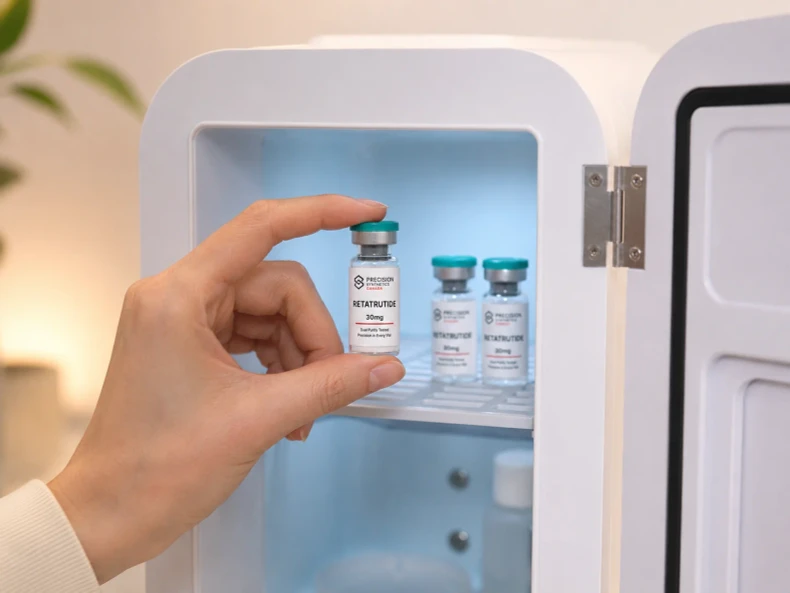
Research peptides generally keep better when stored cold, dry and away from light. Start with the temperature on the vial label or supplier's storage sheet, then distinguish between a sealed, freeze-dried vial and a peptide that has already been dissolved: adding liquid usually makes storage more demanding.
| Storage situation | Practical decision |
|---|---|
| Sealed dry vial | Follow the supplier's temperature. −20°C or colder is commonly recommended for longer storage; refrigeration around 4°C can suit shorter storage. |
| Reconstituted vial | Refrigeration around 4°C (2–8°C) is a common short-term condition. Follow any more specific instruction for the peptide solution. |
| A few hours at room temperature | Return a dissolved sample to its specified storage condition. Record the time and temperature before assessing it for the planned experiment. |
| Overnight at room temperature | Return it to its specified storage condition and record the exposure. Its suitability requires stability evidence for that preparation. |
| Several days at room temperature | Set the sample aside if its stability under those conditions is unknown. Follow up with the supplier before relying on it in research. |
| Direct sun or a hot vehicle | Set aside a heat-exposed sample when its stability is unknown; heat can alter the material and affect the research result. |
| The liquid still looks clear | Normal appearance cannot establish how much intact peptide remains. Keep the storage history with the sample. |
Sealed dry vials
For longer storage, −20°C or colder is commonly recommended for lyophilized peptides, meaning peptides supplied as a freeze-dried powder or cake. Some require colder conditions, so keep any more specific instruction supplied with the vial. A refrigerator around 4°C can suit short-term storage of many dry peptides, while the freezer is the usual choice for keeping them longer.
Keep the vial tightly sealed and protected from moisture and bright light. Before opening a cold vial, let it reach room temperature while still sealed so moisture from the air does not collect inside. Our guide to why peptides are supplied dry explains how removing water helps preserve them.
After liquid has been added
A reconstituted peptide is a peptide dissolved in liquid, and its storage life changes with the peptide, concentration and liquid used. Refrigeration around 4°C, within a 2–8°C range, is a common short-term condition for peptide solutions. Prepare only what the research work requires, label the preparation date and keep the vial cold between uses.
Longer storage may involve freezing small portions, called aliquots, so the whole sample does not have to be thawed repeatedly. Use that approach when freezing is suitable for the particular peptide solution; repeated freezing and thawing can encourage clumping or other changes. Adding bacteriostatic water also leaves the peptide's own storage requirements in place, so keep the water vial's instructions separate from the prepared sample's. We cover the original water vial in How to Store Bacteriostatic Water.
If a vial has been left out
A sealed dry vial arriving at room temperature can be consistent with normal peptide shipping. Suppliers including Thermo Fisher and Bachem ship many dry peptides this way, then recommend cold storage on arrival. Put the vial at its specified storage temperature rather than treating the shipping condition as a shelf-storage instruction.
For a dissolved sample left out for a few hours or overnight, return it to its specified storage condition and record the time and approximate temperature. Whether it can still support the planned experiment requires evidence for that preparation; a universal hourly cutoff would give false certainty. Set aside samples exposed to prolonged heat or direct sunlight when their stability is unknown, because an altered sample can distort the research result.
Check for leakage, a damaged seal, unexpected particles or a change in colour before working with a stored vial. A normal appearance cannot establish how much intact peptide remains, so keep the storage history with the sample. Keeping unused stock dry, preparing smaller working amounts and limiting temperature changes makes that history easier to manage.
Sources and context
These are general research-peptide handling principles, rather than a tested expiry period for every vial. The temperature and storage time supplied for the exact peptide preparation take priority.
Thermo Fisher: Custom Peptide Storage and Dissolution; Bachem: peptide storage and shipping guidance; MilliporeSigma: handling and storage guidelines.
Research-use notice: Precision Synthetics Canada products and documentation are provided strictly for lawful, non-clinical laboratory research purposes only. COAs and testing records are not medical documents, safety guarantees, sterility guarantees, therapeutic endorsements, dosing guidance, or approval for human or veterinary use.