
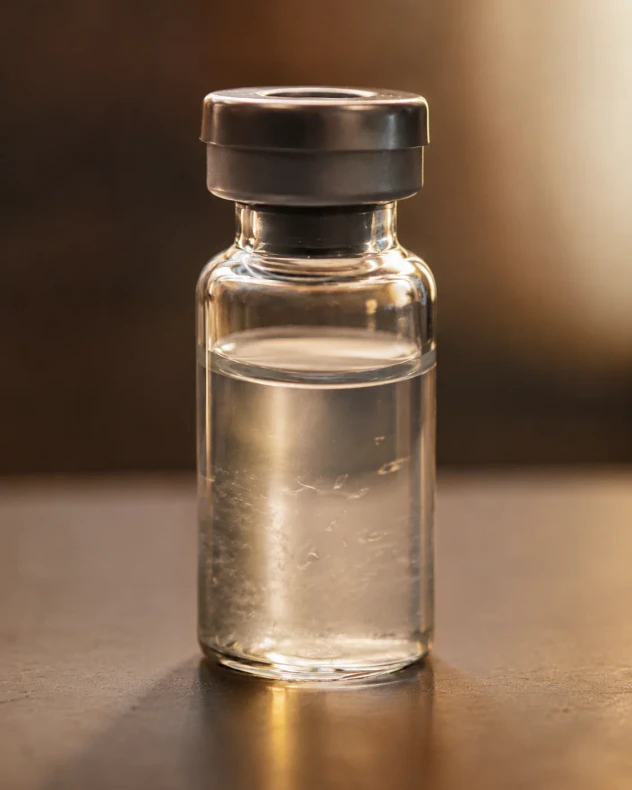
A gel-like patch that appears exactly where diluent first touches the dry cake and then disappears completely can be part of the powder becoming wet and dispersing. In that sequence, the temporary patch alone does not show that the vial was ruined. The concern changes when material remains as jelly, strings, flakes, or haze, or when it disappears and later comes back.
The most useful detail is what happened next. A single photograph of the first wetting stage can make an ordinary dissolution process look much stranger than it is, while a patch that persists or returns describes a different problem.
The first wetting stage
A freeze-dried cake is porous rather than solid all the way through. Diluent reaches the outside first, so a small amount of liquid may briefly hold a large amount of the vial's contents. That concentrated area can look thick, sticky, or jelly-like while the dry material is spreading into the rest of the liquid.
As more of the cake becomes wet, the concentrated area can thin and disappear. This is dissolution: the dry material disperses into the liquid until no visible solid or thick layer remains. The temporary texture is therefore most informative when it is considered together with the final appearance of the entire vial.
Read the full sequence
| What you observe | How to interpret it | Practical response |
|---|---|---|
| A thick patch forms at first contact, steadily shrinks, and disappears completely into a uniformly clear liquid | This fits uneven first wetting followed by dissolution | The temporary patch by itself is not a reason to reject the vial |
| A jelly-like lump remains after the surrounding liquid has become clear | Some material has not dispersed evenly | Keep the vial out of use and send the supplier a photo with the product and lot number |
| Strings, flakes, haze, or visible particles remain | The finished liquid still contains an unresolved visible change | Ask the supplier to investigate or replace the vial |
| The vial becomes clear and gel-like material appears again later | This is a later physical change rather than the original wetting stage | Keep it out of use and contact the supplier; the separate guide to cloudy peptide vials covers changes that develop later |
The clear liquid above a persistent lump should not be treated as though it represents the completed mixture. Material still sitting at the bottom can include some of the peptide or other ingredients from the dry cake, leaving the upper and lower portions uneven.
When the supplier needs to see it
For material that remains or returns, photograph the vial and retain the product name, lot number, and the identity of the diluent. Tell the supplier whether the patch appeared on first contact, whether it disappeared completely, and whether it came back after the vial had looked clear. Those details are more useful than describing everything as "gelling."
Do not use only the clear portion or alter the vial in an attempt to force persistent material to disappear. The supplier should determine whether the appearance is expected for that exact product or arrange a replacement when it cannot be explained.
Use the full sequence to interpret the vial. A patch confined to the first wetting stage that fully disperses fits the ordinary dissolution process; material that remains, produces strings, haze, or particles, or returns later should be treated as an unresolved vial and reported to the supplier for review or replacement.
Sources and context
First wetting and viscosity. Kulkarni et al. (2020) and Kulkarni et al. (2021) studied concentrated freeze-dried protein formulations. Their work supports the explanation that wetting, liquid penetration, cake structure, and a highly concentrated liquid beside the dissolving cake can affect early texture and reconstitution time. The experiments were not prevalence or safety studies of commercial research peptide vials.
Persistent visible material. The MilliporeSigma Peptide Handling Guide and NIBSC's manufacturer-supplied peptide guidance discuss persistent gel, haze, and visible material in connection with incomplete dissolution or suspended material. No universal clearing time can be inferred for an unidentified vial.
Research-use notice: Precision Synthetics Canada products and documentation are provided strictly for lawful, non-clinical laboratory research purposes only. COAs and testing records are not medical documents, safety guarantees, sterility guarantees, therapeutic endorsements, dosing guidance, or approval for human or veterinary use.