
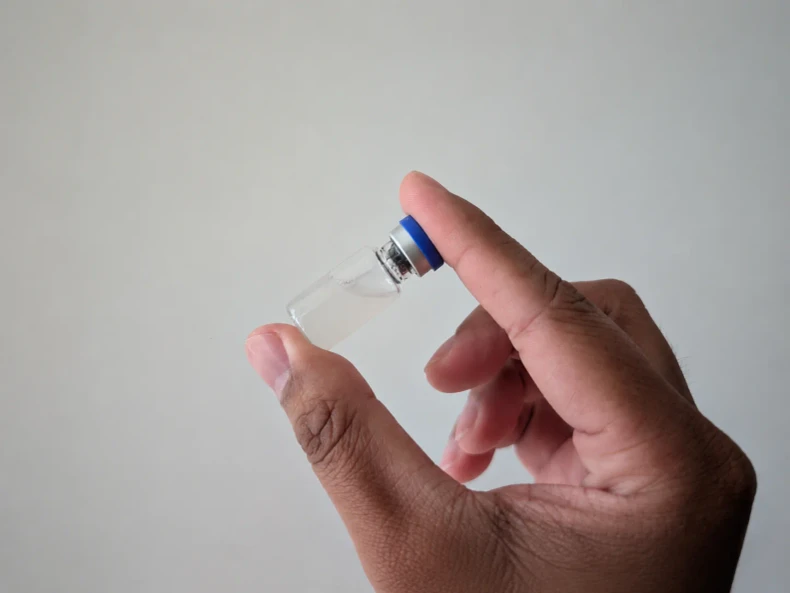
Rounded air bubbles or a little surface foam introduced while liquid is added can settle and look different from haze or solid material. Once those bubbles have settled, a vial that remains unexpectedly cloudy or hazy, contains particles, flakes, gel or strings, is discoloured, or has changed from clear to cloudy should not be injected or otherwise used. Preserve the affected vial unchanged, photograph it, record the lot and preparation history, and contact the supplier. If the supplier cannot provide a product-specific explanation supported by evidence and a clear resolution, discard the vial through the appropriate local route.
Bubbles, foam and persistent haze
Air bubbles usually appear as rounded, reflective circles that rise, join together or collect near the surface. Brief foam is concentrated where the liquid meets the air. Give the bubbles time to rise and the foam time to collapse, then inspect the vial again to see whether any haze or solid material remains.
Persistent haze looks more like light scattered throughout the liquid, while flakes, grains, fibres, sediment, gel or strings remain visible as material within it. Some approved injectable products are expected to look slightly pearly or opalescent, and that appearance is written into their own product instructions. A research peptide vial has no such exception unless the supplier can show a written appearance specification for the exact product and batch.
| What the reader sees | What it may represent | Responsible decision |
|---|---|---|
| Rounded bubbles only | Trapped air | Let settle; inspect again |
| Brief surface foam | Air at the surface | Let settle; inspect again |
| Persistent haze or milkiness | Fine precipitate, aggregation, incompatibility or contamination | Stop; preserve; contact supplier |
| Flakes, grains, sediment or fibres | Precipitate or foreign material | Stop; preserve; contact supplier |
| Gel or stringy material | Aggregation, phase change or contamination | Stop; preserve; contact supplier |
| Unexpected colour | Degradation, contamination or formulation change | Stop; preserve; contact supplier |
| Initially clear, later cloudy | Instability or contamination | Stop; preserve; contact supplier |
| Slight pearly haze specifically listed as normal in the exact product instructions | Expected appearance for that product | Follow those exact instructions; otherwise stop and contact supplier |
Peptide can remain present after it leaves solution
A peptide can remain chemically recognizable after some of it has come out of solution. Concentration, pH, ionic environment, formulation ingredients, temperature, agitation and contact with surfaces can influence whether peptide molecules remain evenly dissolved or associate into larger structures. Fine precipitate or aggregates can scatter light and create haze, while heavier material may settle or cling to the glass.
An anonymized testing-laboratory discussion described a retatrutide sample with visible precipitate. The clear liquid above the solid produced no peptide signal under the initial HPLC preparation, while the recovered solid produced a strong peptide result after different sample preparation. In that vial, recognizable peptide had collected in the solid instead of remaining evenly dissolved through the liquid.
The laboratory result answered one narrow question: recognizable peptide was present in the precipitate. It could not identify all of the visible material, measure how much remained dissolved, or show whether the concentration was even throughout the vial. Sterility, endotoxin, contamination, degradation and suitability for use were still unresolved.
A high HPLC purity result cannot clear the vial
HPLC purity compares the chromatographic peaks in the part of the sample that was prepared and reached the instrument. If material has settled or stuck to the vial, the result can miss that portion unless the sample preparation recovers it. A result such as 99% HPLC purity cannot show that the original vial was evenly mixed or contained the expected amount in every portion.
HPLC can help confirm identity and estimate chromatographic purity when the method is suitable. It does not test whether the vial is sterile or free from endotoxin, heavy metals or unidentified particles; each question needs a separate test. Do not open or sniff a cloudy vial to investigate it.
Vehicle, concentration and pH can affect appearance
Peptides can become less soluble when concentration is high, pH shifts, salts change, or formulation ingredients interact, and the resulting particles scatter light as haze or milkiness. Pinning the change on the bacteriostatic water, pH, filler, counterion or contamination requires testing the affected vial and reviewing how it was prepared.
The liquid used for preparation should also be inspected before it is added. The current Pfizer/Hospira Bacteriostatic Water for Injection label says not to use the water unless the solution is clear and the seal is intact, so a water vial that is itself cloudy or contains visible material should not be used.
A solution that was clear and becomes cloudy hours or days later should be preserved and taken out of use. The change can be associated with physical instability, degradation or contamination, and sight cannot distinguish among them. A clear vial from the same kit does not validate the affected one because the problem may be limited to one vial, one closure, one preparation event or one storage history.
Making a cloudy vial clear by adding acid, buffer or more liquid does not make it safe to use. The added liquid changes solubility and may pull precipitated material back into solution, while sterility, endotoxin, degradation, particle identity and concentration remain unknown. Leave the vial unchanged so the supplier or laboratory can inspect the condition that caused concern.
Preserve the affected vial for supplier review
The affected vial contains the evidence needed to investigate the complaint. Keep it sealed, do not filter, heat, dilute, adjust, open or sniff it, and retain the packaging and matching COA. If the supplier arranges laboratory examination, the cloudy vial should be examined; a clear vial from the same kit may serve as a comparison only when requested and cannot replace the affected sample.
Send the supplier a concise record containing the details below. Keep the description factual so the supplier can compare the appearance with the product, lot, vehicle and preparation history.
- the product name and lot number;
- the matching COA;
- the name and lot number of the liquid used;
- the approximate amount of liquid added;
- whether that liquid was clear before use;
- whether the cloudiness appeared immediately or developed later;
- the storage history and any unusual temperature exposure;
- photographs against both light and dark backgrounds; and
- whether the material floats, settles or clings to the glass.
Ask the supplier for an explanation tied to the exact product, lot, formulation and preparation history, along with a clear resolution for the affected vial. When the supplier cannot provide both, discard the vial through the appropriate local route rather than experimenting with it or using a clear vial from the same kit as proof that the cloudy one is acceptable.
When the vial should be discarded
Once temporary bubbles or foam have settled, persistent unexpected haze, milkiness, particles, gel, strings, discolouration or a change from clear to cloudy is a stop signal. Preserve the affected vial, document what happened and contact the supplier, because continued use would rely on assumptions about particle identity, concentration, sterility and contamination that appearance cannot support.
Chemically recognizable peptide can remain in a precipitate while the cloudy vial is unevenly mixed and its sterility and stability remain unknown. If the supplier cannot resolve those questions with product-specific evidence and a concrete remedy, the affected vial should be discarded.
Sources and context
Official and regulatory sources:
- Health Canada, Labelling of Pharmaceutical Drugs for Human Use - recommends that injectable-product directions tell readers to inspect for clarity, particulate matter, precipitation, discolouration and leakage, with optional wording not to use a solution showing haziness or particles.
- FDA, Inspection of Injectable Products for Visible Particulates - a December 2021 draft guidance describing visible-particle control as a broader process of inspection, identification, investigation and corrective action.
- FDA, Immunogenicity Assessment for Therapeutic Protein Products - discusses aggregation and the need for multiple analytical approaches. It concerns therapeutic proteins and does not quantify risk for a particular research peptide.
- FDA, Drug Quality Sampling and Testing Programs - shows that visual examination, identity, assay, impurities, pH, sterility, bacterial endotoxins and particulate testing are separate quality questions.
- Pfizer/Hospira, Bacteriostatic Water for Injection, USP label - directs users not to use the water unless the solution is clear and the seal is intact, and to inspect reconstituted drugs for clarity, unexpected precipitation and discolouration.
- FDA, YUVIWEL prescribing information - a product-specific example that distinguishes normal air bubbles from unacceptable cloudiness, discolouration and visible particles.
- FDA, ENBREL prescribing information, 2012 label - a product-specific example separating residual foam or bubbles from persistent cloudiness or particulate material. Its instructions are not applied to unrelated products.
- FDA, Certain Bulk Drug Substances for Use in Compounding that May Present Significant Safety Risks - identifies aggregation and peptide-related impurities as potential concerns for certain compounded peptides; it is not a finding about retatrutide or any specific vial discussed here.
Peer-reviewed context:
- Zapadka et al., Factors affecting the physical stability (aggregation) of peptide therapeutics - reviews concentration, pH, excipients, impurities, surfaces, temperature, agitation and other influences on peptide aggregation.
- Marassi et al., Application of AF4-Multidetection to Liraglutide in Its Formulation - illustrates the analytical complexity of characterizing peptide aggregation in a formulated product.
- Zhang et al., A new strategy for enhancing the stability of lyophilized protein: the effect of the reconstitution medium on keratinocyte growth factor - demonstrates that reconstitution medium can affect precipitation and recovery of soluble material in a specific experimental protein system.
- Srinivasan et al., Stability characterization and appearance of particulates in a lyophilized formulation of a model peptide hormone: human secretin - reports changes in peptide content and particulate appearance during storage in a specific model formulation.
- De Groot et al., Immunogenicity risk assessment of synthetic peptide drugs and their impurities - reviews why peptide-related impurities require dedicated assessment rather than inference from a single purity result.
The retatrutide example in the article is an anonymized laboratory observation rather than a controlled study. It explains how precipitated material can retain a peptide signal under different sample preparation and is not used to estimate prevalence, diagnose a cause or establish the safety of any research vial.
Research-use notice: Precision Synthetics Canada products and documentation are provided strictly for lawful, non-clinical laboratory research purposes only. COAs and testing records are not medical documents, safety guarantees, sterility guarantees, therapeutic endorsements, dosing guidance, or approval for human or veterinary use.