
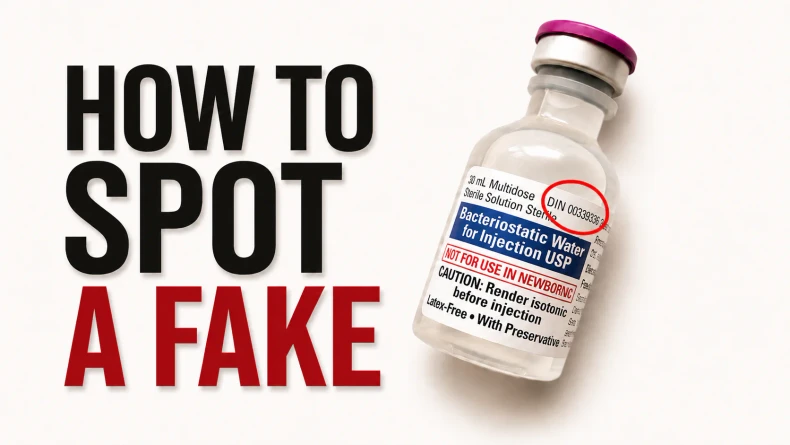
If you've seen posts warning about fake Pfizer or Hospira bacteriostatic water, you've probably seen the photos too: two vials side by side, a circle around the cap, and a caption saying one of them is counterfeit. A photo can't tell you whether a vial is real. Genuine labels differ between Canada and the U.S., they've changed over the years, and fakes can copy both the artwork and the numbers.
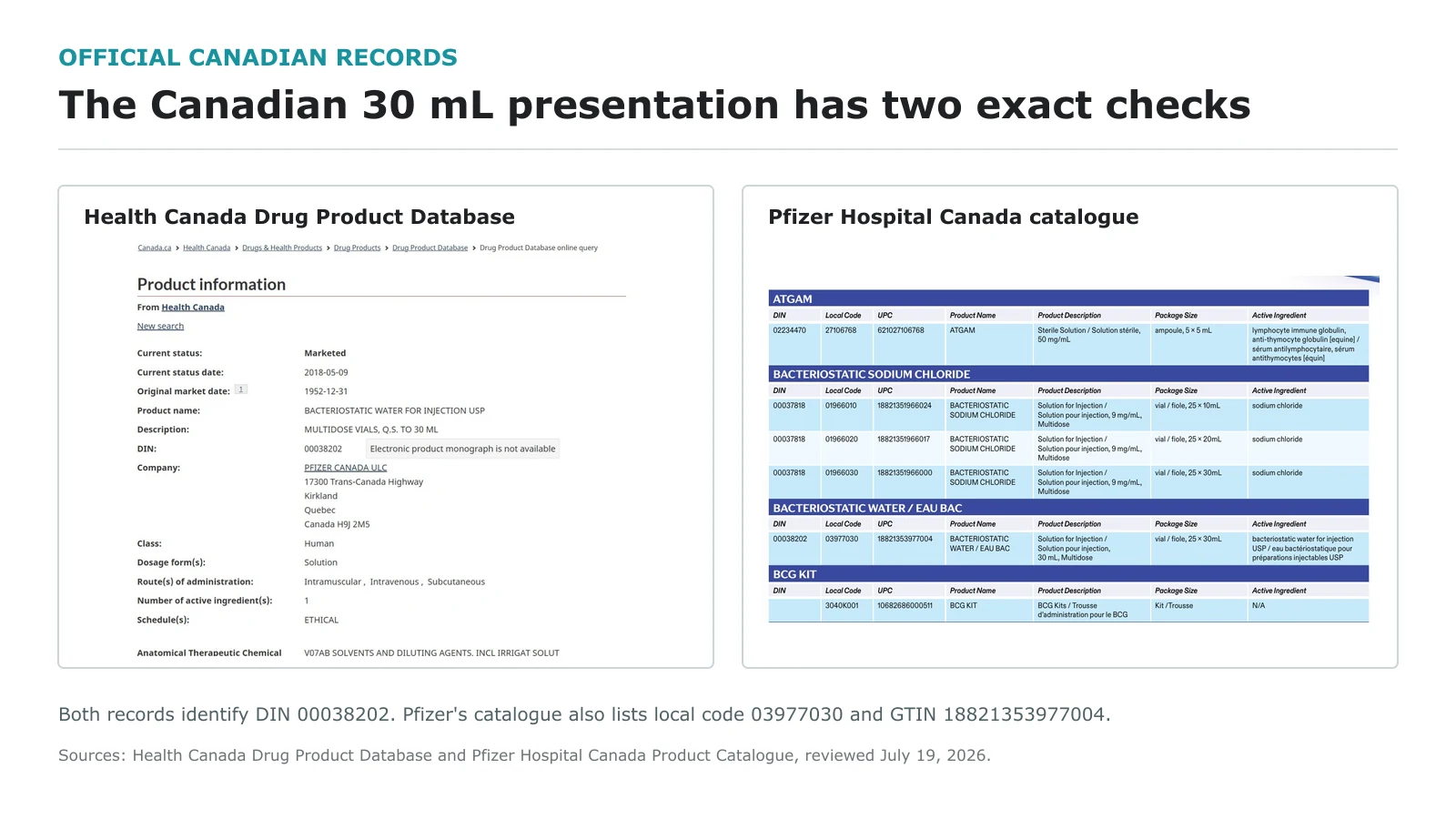
What you can check is whether the vial matches the official record for its country, then its trail: lot number, expiry, seal, liquid and seller. This guide covers the current 30 mL Canadian vial with DIN 00038202, the same Pfizer vial we stock as our Pfizer Bacteriostatic Water 30 mL, and the U.S. Hospira 0.9% vial with NDC 0409-3977-01.
Canadian and U.S. Vials Carry Different Numbers
Canada identifies drugs with an eight-digit DIN, while the U.S. uses an NDC. A Canadian vial will look "wrong" next to a photo of the U.S. version, and that's expected. A U.S. vial with an unfamiliar NDC can also be legitimate if a repackager is named in DailyMed and traced back to Hospira.
| Vial | What the official record says |
|---|---|
| Canada, 30 mL | Health Canada lists Bacteriostatic Water for Injection USP from Pfizer Canada ULC as a marketed product under DIN 00038202. Pfizer Hospital Canada's September 2025 catalogue gives it local code 03977030 and GTIN 18821353977004, sold as a pack of 25 × 30 mL vials. |
| U.S. Hospira, 30 mL | The single semi-rigid plastic Fliptop vial is NDC 0409-3977-01, and the tray of 25 is NDC 0409-3977-03. The current version contains 0.9% benzyl alcohol (9 mg/mL). |
| U.S. repackaged, 30 mL | A different NDC can be fine when DailyMed names the repackager and links the package back to Hospira's NDC 0409-3977. Two current examples are HealthFirst NDC 51662-1473-1 and ProPharma Distribution NDC 84549-977-03. |
Always check a number together with the product name and size. NDC 0409-1966-12 gets passed around online as 30 mL Hospira bacteriostatic water, yet DailyMed lists it as a tray of 25 × 10 mL vials of bacteriostatic sodium chloride, which is a different product. DailyMed also keeps an older 20 mL, 1.1% Hospira version (the 0409-1093 family), so name, strength, size and package all need to line up.
Real Labels Change Over Time
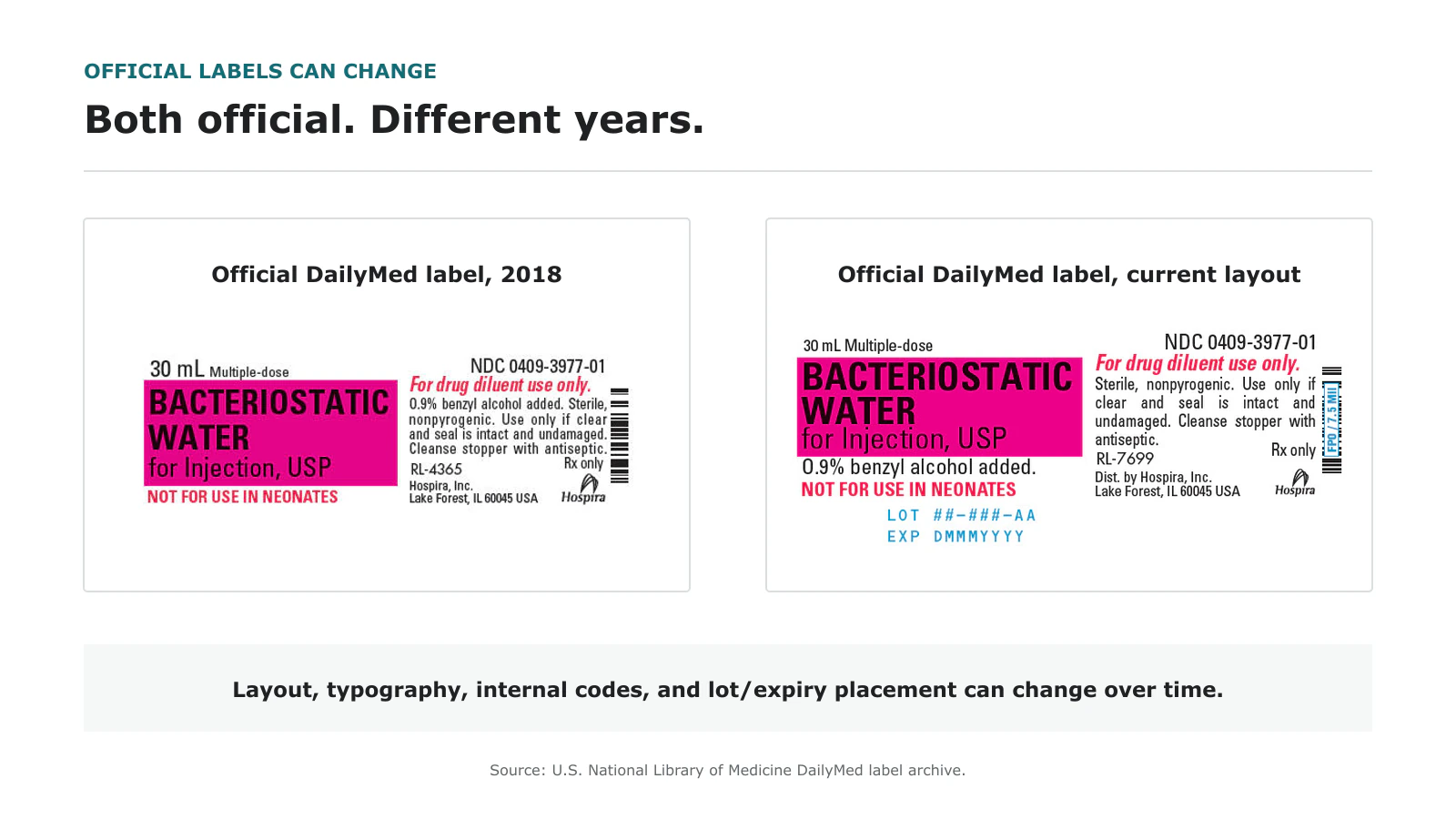
Hospira has redesigned its label more than once. The 2018 and 2024 versions in DailyMed's archive use different fonts and different internal label codes, and they print the lot and expiry in different places. Both are genuine, so a vial that doesn't match today's design isn't automatically a fake.
Repackaged vials add more variety. When the repackager's name, its NDC, the original Hospira NDC and the package size all agree in the record, the vial has a paper trail. An NDC you don't recognize is a reason to look it up in DailyMed before deciding anything.
Signs Worth Following Up
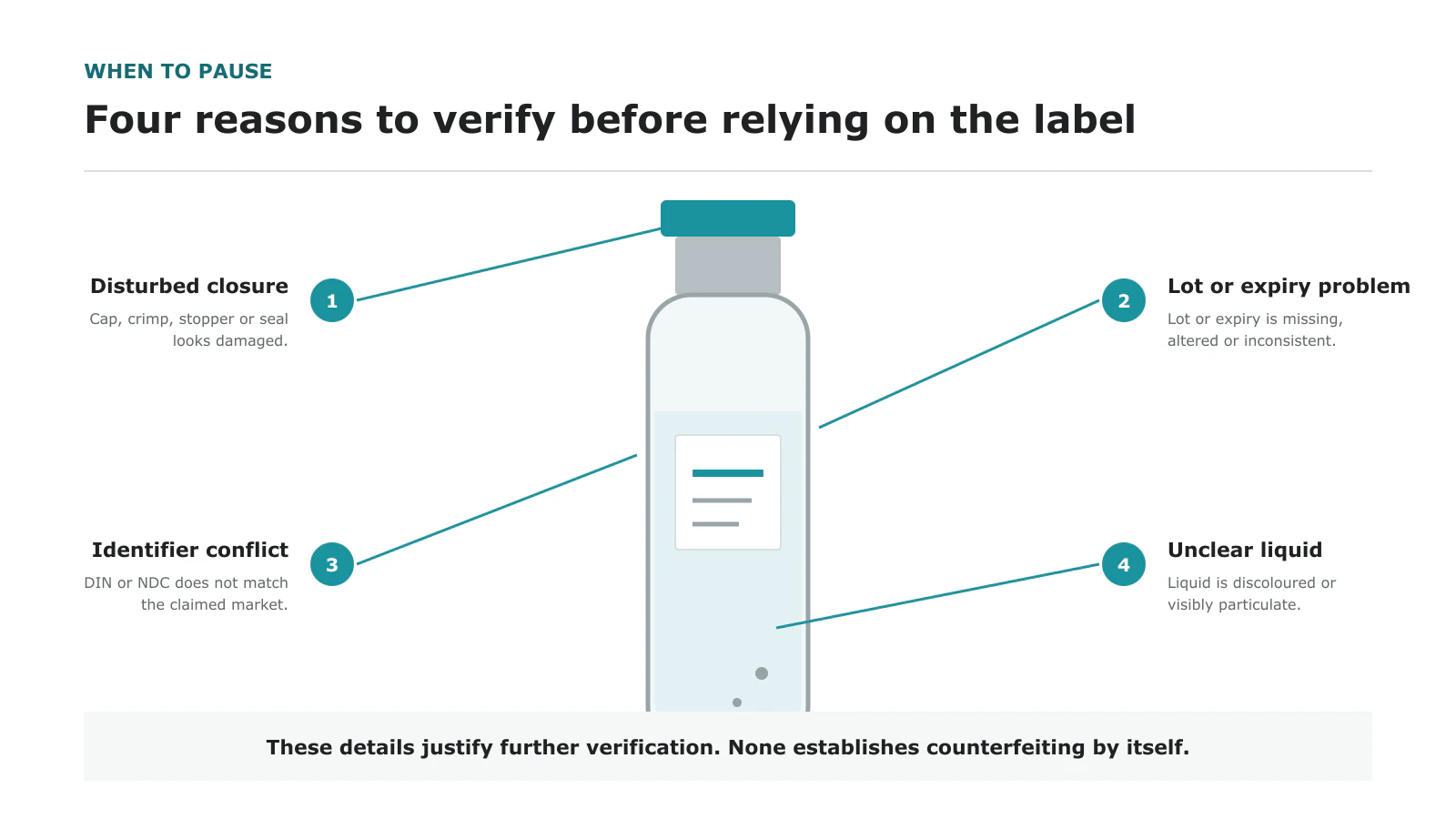
Looks start to count when they contradict the record: a Canadian 30 mL vial with no eight-digit DIN, a DIN that belongs to another product, a U.S. number nobody can trace, covered or mismatched lot details, a disturbed seal, or liquid that is discoloured or has visible particles. Those are concrete problems Pfizer or Health Canada can investigate.
The details people argue about most are much weaker on their own: cap shade, cap embossing, fonts, how straight the label sits, fill level, the bottle seam, price, a dot-matrix style mark and smell. Buyers can't even agree whether the FLIP OFF embossing points to a fake. Our article on why cap colour is not a certificate of analysis explains why packaging details make poor proof of what's inside a vial.
Posts from 2025 and 2026 keep raising the same points: cap embossing, missing lot details, odd bottle shapes, uneven fill, altered-looking labels and products that didn't match the listing photo. The Telegram groups we read add claims of fakes "flooding the market" and arguments about neck shape and marks on the silver crimp.
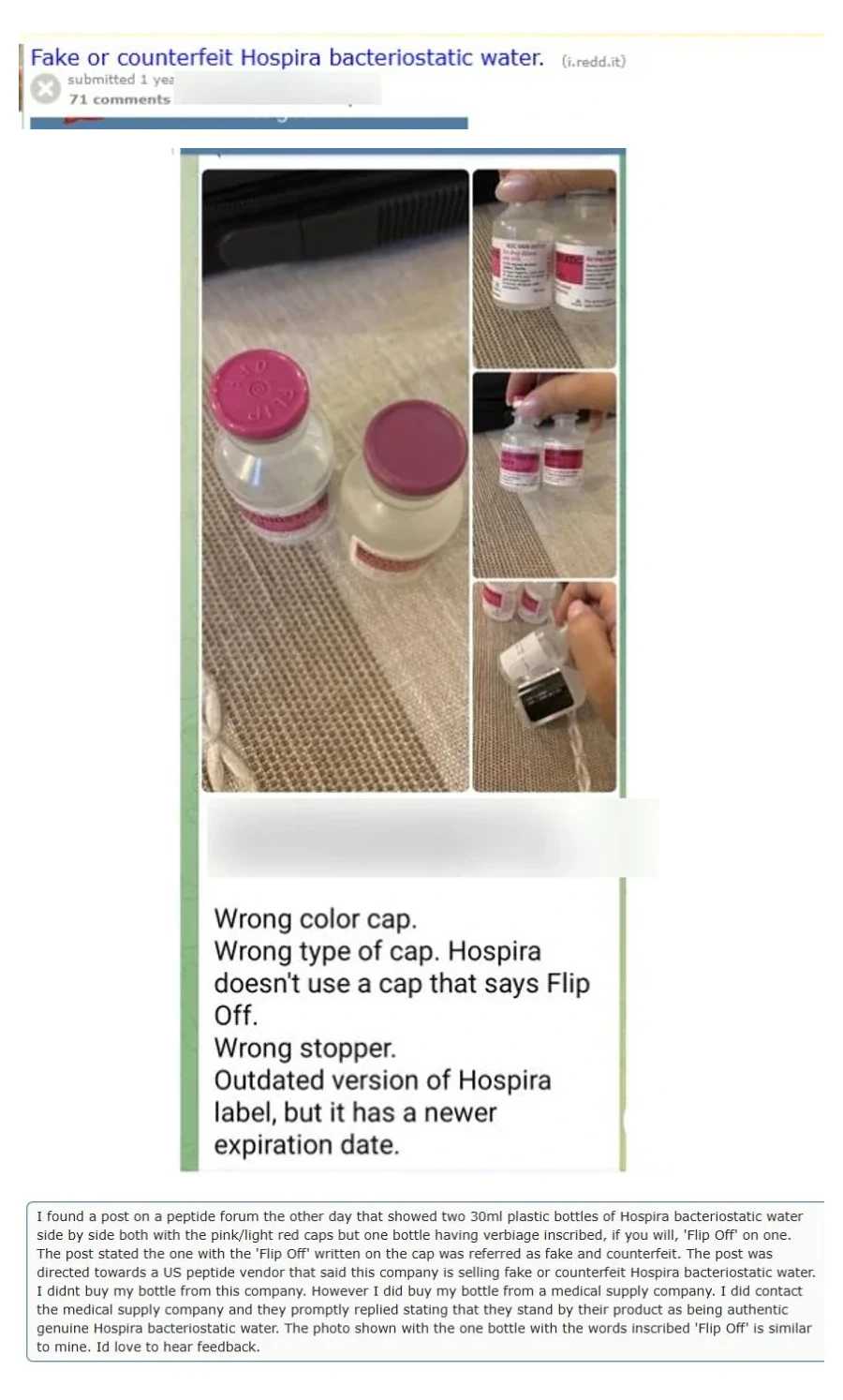
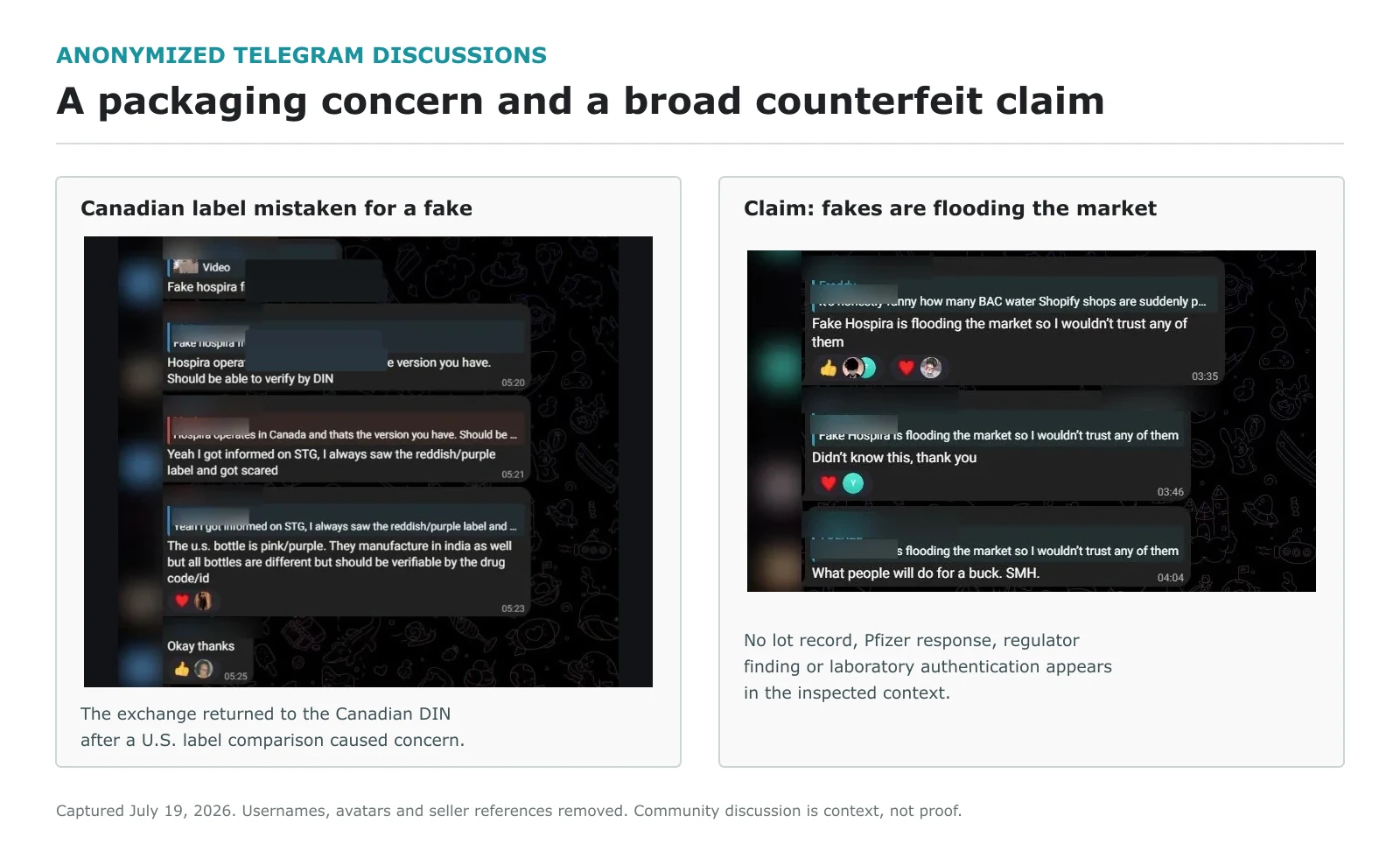
In one chat, someone flagged a Canadian label because it didn't look like the U.S. version, and the group ended up back at the DIN, which is the right check for a Canadian vial. The worry is clearly widespread, but with no manufacturer investigation or lab work on the pictured vials, none of these photos settles anything.
Pfizer itself says lab testing is needed to confirm with certainty that a product is genuine, and that the usual visual clues may not be there. Health Canada says counterfeit prescription products can look identical to the real ones. Photos are still worth keeping because they help an investigation get started.
When we searched Pfizer, FDA and Health Canada sources up to July 24, 2026, we didn't find a counterfeit alert for Pfizer or Hospira bacteriostatic water. The official event that does come up is the 2019 recall of lot W20308 over a possible lack of sterility assurance, which was a manufacturing problem rather than a counterfeit. That only reflects what those sources showed on that date.
If You Think You Have a Fake
Take clear photos of every side of the label, the lot and expiry, and close-ups of the cap, crimp, rubber stopper and seal. Keep the receipt or invoice, the seller's listing and any messages with them. Health Canada's complaint process asks for exactly these, because they let an investigator follow the trail.
You can reach Pfizer Canada Medical Information at 1-800-463-6001 and Pfizer Canada Customer Service at 1-800-387-4974. Health product complaints go to Health Canada's compliance directorate at 1-800-267-9675. Pfizer can check a lot number against its own records, which no photo can do.
Where Our BAC Water Comes From
We get our Pfizer Canada stock from a reliable source and keep the invoices for every purchase. Our stock matches the official record for Pfizer Canada ULC and DIN 00038202, and we guarantee the authenticity of the Pfizer bacteriostatic water sold by Precision Synthetics Canada. That guarantee covers our own stock, which we can trace through those invoices, and we can't vouch for another seller's vial from a photo. Our stock is listed on our Pfizer Bacteriostatic Water 30 mL product page.
Sources and context
- Canadian product records: Health Canada Drug Product Database and Pfizer Hospital Canada Product Catalogue.
- U.S. product records: current Hospira label and archive, Bacteriostatic Sodium Chloride record, and the DailyMed repackager search.
- Authentication limits and sourcing context: Pfizer's identification article, Pfizer counterfeiting guidance, and Health Canada counterfeit guidance.
- Contacts, reporting, and the dated recall distinction: Pfizer Canada contacts, Health Canada complaint guidance, and the FDA-posted 2019 Hospira recall.
- The community screenshots show what buyers are worried about. They are not authentication by Pfizer, a regulator or a laboratory.
Research-use notice: Precision Synthetics Canada products and documentation are provided strictly for lawful, non-clinical laboratory research purposes only. COAs and testing records are not medical documents, safety guarantees, sterility guarantees, therapeutic endorsements, dosing guidance, or approval for human or veterinary use.