
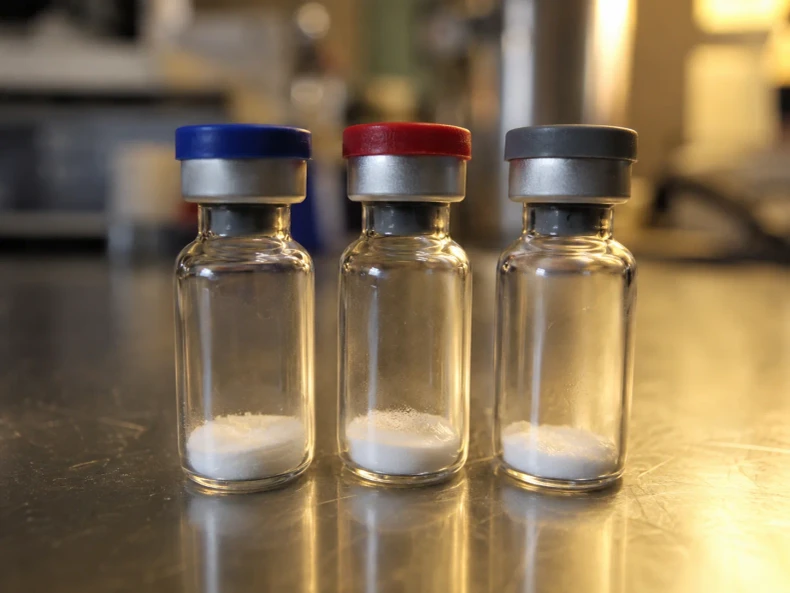
Retatrutide has no universal or official generic-vial cap colour. Blue, orange, red, purple, clear, grey, or another cap may be used by different suppliers or for different batches. A supplier may use cap colour as an internal stock or batch convention, while another supplier may assign that same colour to a different compound or labelled amount. Cap colour alone cannot establish that the vial contains retatrutide.
The search phrase “what color is retatrutide” can also refer to the material inside the vial. Retatrutide test records commonly describe the dry material as white lyophilized powder, but the colour, size, and shape of the cake cannot establish molecular identity. For a mixed solution, use the supplier’s appearance specification for that exact material and formulation rather than a colour claimed online. If the liquid is unexpectedly cloudy, discoloured, or visibly particulate, see Why Is My Peptide Cloudy After Reconstitution?.
Retatrutide cap colours vary by supplier and batch
Commercial vial-closure manufacturers sell flip caps and aluminium seals in many colours and configurations. Colour is a selectable packaging feature alongside the button finish, shell colour, lacquer, and seal configuration; manufacturers do not reserve blue, red, purple, or any other colour for retatrutide.
Cap colour belongs to the supplier’s local system. One supplier may use a colour to separate compounds, labelled amounts, packaging runs, or stock groups, while another supplier can use the same colour for a completely different item. A colour change may coincide with a different batch, a packaging-supply change, or an internal catalogue convention, so the changed cap does not prove that a new batch was produced.
Recent community discussions show why buyers ask about this. In one discussion, a buyer reported that a labelled 30 mg presentation had previously arrived with purple caps and later arrived with red caps; replies disagreed over whether the change indicated a new batch or simply a different supply of caps. Earlier discussions describe similarly mixed experiences across orders, which makes them useful context for the question rather than scientific authority.
Publicly posted records represented as retatrutide also show non-uniform packaging. One batch listing identifies a blue cap with a silver crimp, while another record describes a clear cap with a bronze crimp. These examples demonstrate the packaging variation found across suppliers without endorsing either seller or establishing product quality, authenticity, or a universal colour standard.
Useful visual cues and their limits
Within one supplier’s catalogue, cap colour can be a useful visual cue. It may help staff organize stock, and it can help a buyer notice that a new package differs from a previous order. Matching caps, seals, and labels across a tray can also make an odd vial, bent crimp, chipped glass, leakage, or another visible discrepancy easier to spot.
Colour alone cannot identify the molecule, labelled amount, measured content, purity, sterility, batch, or authenticity. The same colour can appear on different compounds or amounts, and different colours can appear on vials represented as the same compound. A changed cap should prompt a comparison of the printed label and exact lot number rather than an assumption about what changed.
Matching caps, labels, and seals reveal whether the visible packaging follows a consistent pattern. The identity test, HPLC purity result, and content result in mg/vial provide the laboratory findings linked to the tested lot.
From vial label to lot-matched COA
Begin with a label that can be read without guessing. The vial or outer package should provide the full compound name, labelled amount, supplier, and exact lot or batch number, which can then be compared with the product listing and COA.
| Field to inspect | How to use it |
|---|---|
| Full compound name and labelled amount | Confirm that the label names retatrutide and shows the same mg presentation as the product listing and COA. |
| Supplier and exact lot or batch number | Use the lot as the bridge between the vial and the report for that same batch. |
| Laboratory name or report identifier | Confirm who issued the analysis and which specific report is being viewed. |
| Identity result | Check whether the listed analytical method identified retatrutide in the tested sample. |
| HPLC purity | Read the reported percentage represented by the main peptide peak; this does not report the quantity in the vial. |
Content in mg/vial |
Check the measured quantity per vial and compare it with the labelled amount. |
| Test name, result, and unit | Read these together so an identity result, percentage, or milligram value is not confused with another test. |
Copy prefixes, hyphens, and leading zeroes in the lot number exactly. A single changed character can point to a different batch or prevent a correct report match.
Identity, HPLC purity, and content in mg/vial answer separate questions. Identity addresses which material the listed method detected, HPLC purity describes the relative main-peak purity reported by the method, and content reports the measured quantity per vial. A COA provides results only for the tests it lists and the sample or samples it identifies; it does not guarantee every untested property of every vial.
If the vial came from us, use our COA library to locate the exact lot and read the listed tests, results, and units. If the compound name, labelled amount, lot number, or report identifier does not align, contact the supplier before drawing any conclusion from the cap colour.
Sources and context
- West Pharmaceutical Services Flip-Off Seal Color Configurator shows commercial choices for button colour, finish, shell colour, and related seal features, supporting the point that cap colour is a packaging option rather than a universal peptide code.
- DWK Life Sciences WHEATON Flip Cap Aluminum Seals provides additional manufacturer context for commercially available flip-cap aluminium seals in different colours and configurations.
- The recent vendor-coloured-cap discussion and the earlier mixed-cap discussion are included only as qualitative evidence of the buyer question and the conflicting assumptions found in community replies. They are not scientific or analytical sources.
- The blue-cap batch listing and the clear-cap with bronze-crimp record are publicly posted examples represented as retatrutide. They are cited only to show packaging variation and are not endorsements, proof of authenticity, or evidence of a universal standard.
- A recent retatrutide test record describes the submitted sample as white lyophilized powder. This supports the dry-material description for that sample without creating a universal visual identity test.
- Our COA library is linked as the practical location for matching one of our lots to the tests and results posted for it.
Research-use notice: Precision Synthetics Canada products and documentation are provided strictly for lawful, non-clinical laboratory research purposes only. COAs and testing records are not medical documents, safety guarantees, sterility guarantees, therapeutic endorsements, dosing guidance, or approval for human or veterinary use.