
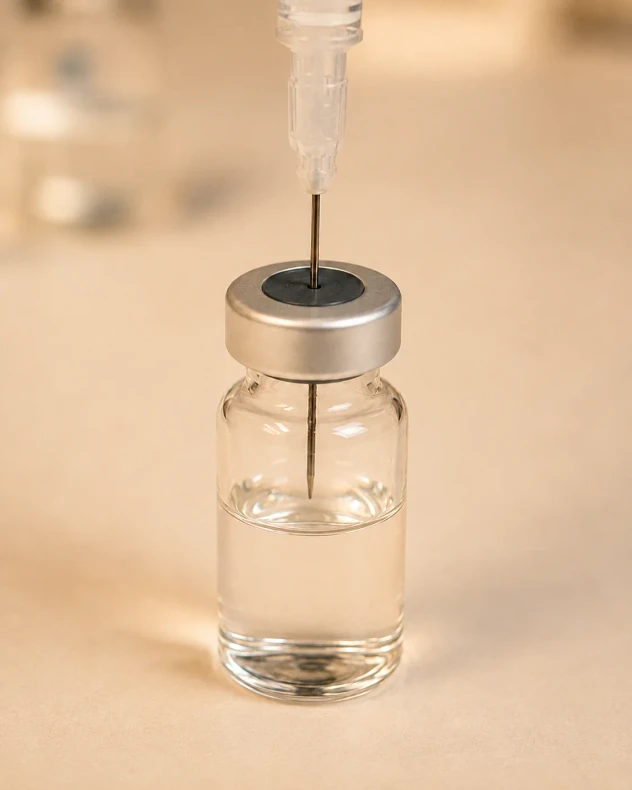
Little or no noticeable suction is generally not a reason to discard a lyophilized peptide vial that has a centred stopper, a firm metal crimp, intact glass, a dry exterior, no leakage, and dry contents without unexpected moisture, discolouration, or foreign material. In that condition, the strength of the pull mostly reflects the pressure difference between the vial and the surrounding air.
Where the suction comes from
The space above the dry material is called the vial headspace. During freeze-drying, vials are commonly left partially stoppered while moisture is removed, then fully stoppered inside the freeze-drying chamber.
A vial may be fully stoppered while the chamber is under vacuum or after a controlled gas has been introduced. The pressure inside the finished vial can therefore differ from one process to another, making the inward pull feel strong, weak, or absent when the stopper is first entered.
A practical reading of the vial
Look at the vial as a whole instead of judging it by the strength of the pull. The stopper, crimp, glass, exterior, and dry contents show whether absent suction is an isolated observation or appears alongside a visible problem.
| What you see | Practical response |
|---|---|
| No noticeable suction, with a centred stopper, firm crimp, dry exterior, intact glass, no leakage, and ordinary-looking dry contents | Lack of suction alone is generally not a reason to discard the vial. |
| A raised, displaced, loose, or previously punctured stopper; a loose or damaged crimp; cracked glass; or leakage | Set the vial aside and contact the supplier. |
| Unexpected moisture, discolouration, foreign material, or broken glass | Set the vial aside and contact the supplier. |
| The supplier states that this exact batch should arrive under vacuum, but the vial shows no noticeable inward pull | Set the vial aside and ask the supplier to review the batch discrepancy. |
An intact, dry vial with no visible damage generally does not need to be discarded solely because the pull felt weak or absent. Set it aside and contact the supplier when the stopper, crimp, or glass is damaged; the vial has leaked; the contents show an unexpected change; or the missing suction conflicts with the supplier's stated expectation for that batch.
Sources and context
FDA, Lyophilization of Parenteral (7/93). This inspection guide describes vials being partially stoppered during freeze-drying and fully stoppered within the freeze-drying chamber.
FDA, Sterile Drug Process Inspections. Its lyophilization section describes final stoppering under vacuum and stoppering after a controlled gas has been used to break the vacuum.
Research-use notice: Precision Synthetics Canada products and documentation are provided strictly for lawful, non-clinical laboratory research purposes only. COAs and testing records are not medical documents, safety guarantees, sterility guarantees, therapeutic endorsements, dosing guidance, or approval for human or veterinary use.