
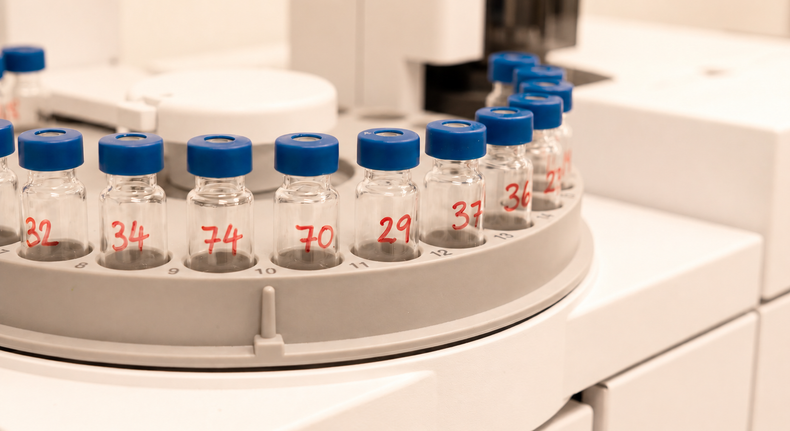
HPLC, LC-MS, and LAL appear together on some peptide testing records because they examine different properties of the submitted sample. HPLC separates components and describes the detected chromatographic profile. LC-MS measures mass-to-charge signals that can support the expected molecular identity. LAL responds to bacterial endotoxin. Reviewing the three results together becomes much easier once the reader knows what happens to the sample inside each test and what the laboratory reports afterward.
| Test | What it measures | What appears on the report |
|---|---|---|
| HPLC | Components separated on a chromatography column and recorded by a detector | Chromatogram, retention times, integrated peak areas, area percentage |
| LC-MS | Mass-to-charge signals from separated, ionized molecules | Ion spectrum, charge states, deconvoluted or observed molecular mass |
| LAL | Biological reagent response to bacterial endotoxin in the test solution | Gel-clot endpoint or quantitative result in endotoxin units |
HPLC: separating the detected components
In high-performance liquid chromatography, a dissolved sample is carried through a column by a flowing solvent. Components move at different rates because each interacts differently with the column material and the mobile phase. A detector records the material as it leaves the column, creating peaks on a chromatogram.
The time at which a peak appears is its retention time, and the integrated area under that peak represents detector response. When a report uses area normalization, the laboratory compares the assigned main peak with the total integrated peak area. The resulting percentage describes the relative detected chromatographic profile under that method.
Method conditions shape the separation. Column chemistry, solvent gradient, wavelength, run time, and integration rules affect which impurities resolve as separate peaks and how strongly they respond. The dedicated article on what 99% peptide purity means explains why this percentage should be kept separate from net peptide content and milligrams per vial.
On a COA, the useful HPLC evidence includes the complete chromatogram, an identified main peak, visible smaller peaks, retention information, method details, and a batch connection. The result supports a statement about detected chromatographic composition. Molecular identity, endotoxin, and microbiological condition remain outside that measurement.
LC-MS: comparing observed mass with expected mass
Liquid chromatography-mass spectrometry begins with a chromatographic separation and then directs the eluting material into a mass spectrometer. The molecules are ionized, often carrying more than one electrical charge. The instrument records mass-to-charge ratios, written as m/z, so one peptide can produce a family of peaks corresponding to different charge states.
Software can deconvolute those charge-state signals into an observed molecular mass. The laboratory compares that value with the mass calculated for the expected peptide. Close agreement supports the assignment of the measured component to the expected molecular formula and is much more specific than relying on HPLC retention time alone.
The strength of the identity conclusion depends on the data collected. Two compounds can share the same nominal or exact mass, and some sequence variants, positional isomers, or modifications require fragmentation data, high-resolution measurements, peptide mapping, or another orthogonal technique to distinguish them. A report that shows the expected and observed masses, the ion spectrum, charge states, and stated tolerance gives the reader more evidence than a line that simply says identity confirmed.
LC-MS can also help characterize impurity peaks when the method is designed for that purpose. Its role on a basic COA is usually narrower: it shows whether the dominant tested component produced mass data consistent with the expected peptide. It does not establish the amount per vial or microbiological quality.
LAL: measuring bacterial endotoxin
Bacterial endotoxins are lipopolysaccharides associated with the outer membrane of Gram-negative bacteria. They can remain after bacterial cells have died, which is why a low viable-bacteria count and a low endotoxin result are different findings. LAL uses a reagent system derived from horseshoe-crab blood cells that reacts to endotoxin; current compendial frameworks also include recombinant reagent approaches to the same bacterial-endotoxin question.
Gel-clot LAL records whether a clot forms at a stated sensitivity. Chromogenic and turbidimetric versions measure colour or cloudiness as the reaction progresses and can produce a quantitative concentration. Results are commonly expressed in endotoxin units per millilitre, per milligram, or another sample-specific unit, so both the number and its denominator need to be visible.
The sample matrix can inhibit or enhance the reaction. Laboratories use controls, dilution limits, and recovery checks to show that endotoxin would still be detected in that material under the chosen conditions. A reported value without the method, units, limit, and suitability controls gives the reader little basis for interpreting the result.
LAL addresses bacterial endotoxin rather than viable organisms, fungal contamination, every possible pyrogen, or sterility. A low result can support a low bacterial-endotoxin finding for the tested sample and method. Sterility and bioburden require separate microbiological procedures.
Reading the three results together
Consider a report with a dominant HPLC peak reported at 99.2% area, LC-MS data showing an observed mass within the laboratory's stated tolerance of the expected mass, and an LAL result below a clearly identified endotoxin limit. Together, those findings support three conclusions about the submitted sample: its detected chromatographic profile was dominated by one assigned component, the measured molecular mass supported the expected peptide, and bacterial endotoxin was below the reported limit under a suitable assay.
The same package still leaves peptide content per vial and sterility to their own tests. It also describes the laboratory sample identified on the report, so the batch number and documentation trail must connect that sample to the material being reviewed. Our batch-to-COA guide explains that final connection.
This division of labour is the useful way to read the acronyms. HPLC describes separation and relative detected composition, LC-MS contributes molecular-mass evidence, and LAL measures bacterial endotoxin. A COA becomes more informative when every result is kept within the question its method was designed to answer.
Sources and context
- The FDA Biotechnology Inspection Guide describes the distinct quality-control roles of HPLC, mass spectrometry, peptide mapping, protein quantification, and LAL: Biotechnology Inspection Guide.
- FDA/ICH Q6A separates identity, assay or content, and impurity testing, and explains why one chromatographic retention time is not sufficiently specific for identity: Q6A specifications guidance.
- The FDA's March 2026 guidance covers bacterial-endotoxin methods, acceptance criteria, and method suitability: Pyrogen and Endotoxins Testing: Questions and Answers.
- The FDA's technical guide explains Gram-negative bacterial endotoxin, LAL method formats, units, interference, dilution, and recovery controls: Bacterial Endotoxins/Pyrogens.
- USP announced recombinant bacterial-endotoxin methods in Chapter 86 alongside the established Chapter 85 framework: USP Chapter 86 announcement.
Research-use notice: Precision Synthetics Canada products and documentation are provided strictly for lawful, non-clinical laboratory research purposes only. COAs and testing records are not medical documents, safety guarantees, sterility guarantees, therapeutic endorsements, dosing guidance, or approval for human or veterinary use.