
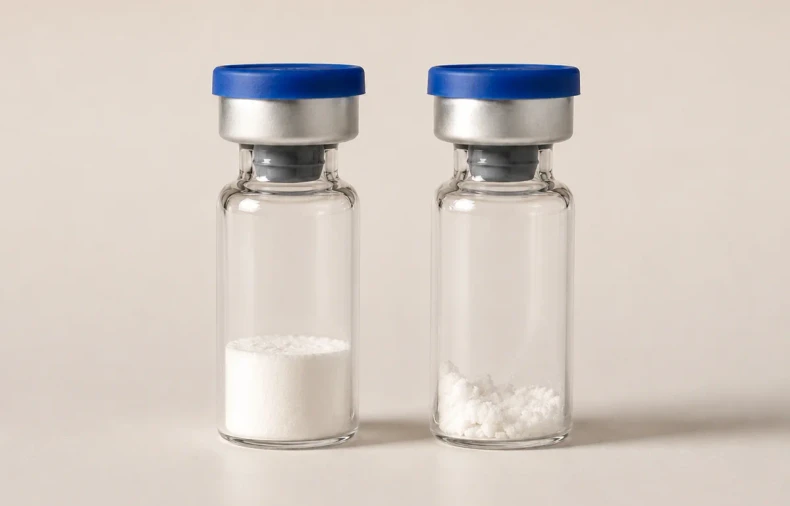
If two lyophilized peptide vials are sealed, dry, free from unexpected colour changes and undamaged, a difference in cake size is usually fine. The visible puck comes from every dried ingredient in the formula and the tiny spaces left after the water is removed, so a taller or wider cake cannot show how many milligrams of peptide are present.
Before drying, the peptide and other ingredients are held in a water-based liquid inside the vial. That liquid freezes, and the ice leaves during drying, creating a light structure full of tiny spaces where the frozen water had been. This dried structure is the cake, or puck, seen through the glass.
The visible puck comes from the whole formula
Some formulas include supporting ingredients added to help the material freeze-dry or hold its shape. When the peptide itself is measured in milligrams, these ingredients may contribute much of the material you can see, so a large share of the puck may come from the rest of the formula.
The starting liquid level also influences the final appearance. Two preparations can carry the same labelled peptide amount in different total liquid volumes, leaving cakes with different heights or widths once the water has been removed.
Vial shape changes the picture again: a wide base spreads the dried material into a lower disc, while a narrow base can make it look taller. Freezing and drying influence whether the finished cake appears light and open, compact and dense, attached to the glass as a thin film, or gathered into a ring. All of these forms can occur without changing the labelled peptide amount.
Vials from the same product and lot can also show modest differences in how the cake settles, pulls away from the glass or forms at the surface. Placing two vials side by side may make those differences look dramatic, but cake height still provides no milligram measurement.
Read appearance as a condition check
A dry cake can pull away from the glass or break into sections during handling, and a crack alone cannot show how much peptide is in the vial. We cover that specific appearance in Why Is My Peptide Vial Cake Cracked?; a fracture accompanied by moisture, leakage, damaged glass or closure damage should be sent for supplier review.
Start by comparing the same product and lot where possible, since different strengths, formulas and vial shapes can look very different. Check each vial for visible moisture, a colour change, particles or other foreign material, leakage, chipped or cracked glass, and damage to the rubber stopper or metal seal. Then copy the lot number from the label and match it to the same lot in our PSC COA library.
One vial that looks markedly different from otherwise identical vials in the same lot deserves supplier review even when the obvious damage signs are absent. Send us clear photographs of the vial, label, cake and closure so we can compare it with the lot information and determine whether the difference needs follow-up.
Appearance can help identify a vial that needs review, but it cannot establish identity, purity, content, sterility, safety or overall quality. A normal-looking cake cannot replace a batch-matched COA, and an unusual shape should be described precisely rather than judged from cake size alone.
The COA result that shows milligrams per vial
Cake size cannot show milligrams per vial. Look for a content result explicitly reported in milligrams per vial on a COA that matches the lot number on the vial label.
Identity testing says which peptide was detected. HPLC purity reports the relative share of the detected material represented by the main peptide peak. Neither result reports how many milligrams of peptide were measured in the vial.
When a batch-matched COA includes a content result in mg/vial, that is the field that addresses the labelled vial amount. If the COA lists only identity and HPLC purity, it answers those separate analytical questions without measuring milligrams per vial. The visible cake cannot supply the missing measurement because it includes the whole dried formula and the spaces left after the water was removed.
When both vials are sealed, dry, free from unexpected colour changes and undamaged, a bigger or smaller cake is usually an ordinary appearance difference. Contact us when you see visible condition problems or one vial that looks markedly different from others in the same lot, and use a lot-matched content result in milligrams per vial to assess the labelled amount.
Sources and context
The freeze-drying explanation draws on the U.S. FDA’s Lyophilization of Parenteral (7/93), Patel et al.’s review of lyophilized cake appearance, Lu et al.’s study of freezing and cake appearance, and the 2020 AAPS PharmSciTech review Lyophilization of Small-Molecule Injectables: an Industry Perspective. Together, these sources describe water removal from a frozen fill and show how formula ingredients, fill conditions, vial presentation, freezing and drying can influence the visible cake.
The FDA document is a 1993 inspection guide and identifies itself as non-binding reference material for agency personnel. The journal articles examine pharmaceutical development and manufacturing; none evaluates a PSC lot or establishes the condition of an individual vial.
Research-use notice: Precision Synthetics Canada products and documentation are provided strictly for lawful, non-clinical laboratory research purposes only. COAs and testing records are not medical documents, safety guarantees, sterility guarantees, therapeutic endorsements, dosing guidance, or approval for human or veterinary use.