
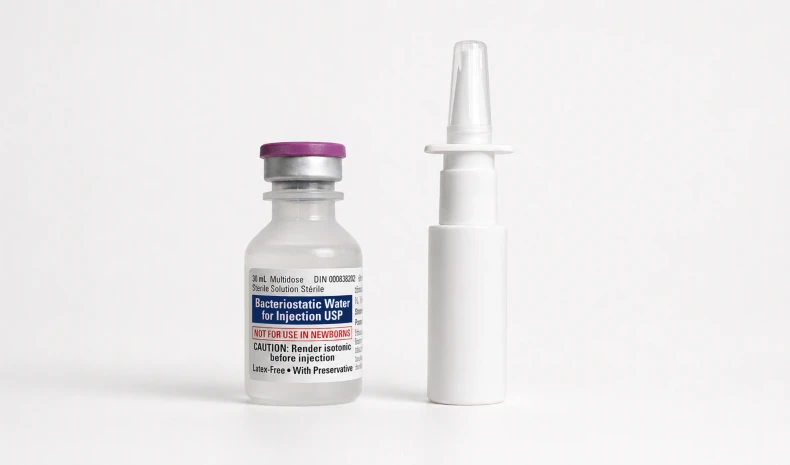
The current 30 mL Hospira Bacteriostatic Water for Injection product is Water for Injection containing 0.9% benzyl alcohol, or 9 mg/mL, which serves as its preservative. Its label describes it as a diluent for injection. It is not saline, carries no claim for nasal use, and provides no evidence about nasal comfort or how the liquid behaves after it is transferred to a metered spray bottle.
That leaves several practical questions unanswered. The liquid and pump together determine the droplets leaving the nozzle, and the size and spread of those droplets influence where the spray lands. Once deposited, mucus and normal nasal clearance begin moving the liquid away, while stinging, sneezing, watery secretion, nose blowing or runoff can redistribute it and make contact less consistent.
The liquid and pump shape where the spray lands
A metered pump is designed to release a repeatable amount of liquid, but the pump does not make every clear liquid produce the same spray. The thickness of the liquid, how readily it breaks into droplets, and its interaction with the nozzle can change the size and spread of those droplets.
Those differences influence where the liquid settles. Larger droplets may collect near the front of the nose or run out, while a narrow or uneven spray can place more liquid on a smaller area. Liquid deposited farther back may also be cleared differently from liquid spread across the front and middle nasal surfaces.
The Hospira label provides no nasal spray pattern, droplet-size information, pump-performance data or comfort assessment. Transferring the liquid to a spray bottle adds a nozzle and pump, but it does not supply the missing evidence about how that combination performs.
Stinging and sneezing can shorten contact
The nasal lining is continually clearing deposited material. Mucus holds the liquid while tiny hair-like structures move it toward the back of the nose, so contact begins changing soon after the spray lands.
Stinging or discomfort can add another source of variation. Sneezing, watery secretion, nose blowing and immediate runoff can move the liquid to another area or shorten the time it remains against the nasal surface. Delivery and absorption may therefore become less predictable, although the effect cannot be reduced to one universal percentage loss.
Benzyl alcohol is the preservative in the named Hospira presentation. In one small intranasal heparin study, two participants reported mild irritation or sneezing that the authors considered consistent with benzyl-alcohol exposure in that formula, a limited finding that cannot predict every person or every formula.
Some purpose-developed nasal products also contain benzyl alcohol as part of a complete formula and device evaluated for that route. Their existence provides no nasal-comfort or spray-performance evidence for an injection diluent transferred into another bottle. Benzyl alcohol is also a different preservative from benzalkonium chloride, so findings about one should not be assigned to the other.
A declared saline vehicle gives a clearer starting point
A saline base provides a declared salt component rather than water preserved with benzyl alcohol alone. A buffer establishes a stated pH target, the preservative ingredients can be identified by name and concentration, and the metered bottle defines the pump being evaluated. These details allow the starting liquid and bottle to be described consistently before spray behaviour or contact is studied.
A purpose-developed nasal vehicle should declare its salt component, pH target, preservative system and metered bottle so the starting liquid and device can be evaluated together. For Canadian product identification and current availability, see our Pfizer Bacteriostatic Water 30 mL page.
BAC water is a poor default nasal spray base because its label answers an injection-diluent question while leaving nasal comfort, droplet formation and metered-pump performance unaddressed. A declared saline-based vehicle gives the research setup a known salt component, pH target, preservative formula and bottle, reducing the basic unknowns that come with transferring an injection diluent into a separate spray pump.
Sources and context
- The current Hospira Bacteriostatic Water for Injection label, updated May 22, 2026, identifies the 30 mL multiple-dose presentation as Water for Injection containing 0.9% or 9 mg/mL benzyl alcohol and labels it as a diluent for injection.
- FDA nasal-spray chemistry and manufacturing guidance and peer-reviewed reviews of nasal device performance, formula effects on droplets and deposition, and nasal clearance support evaluating the liquid and pump together. These sources address purpose-developed nasal products and general delivery principles rather than testing Hospira BAC water as a nasal vehicle.
- The peer-reviewed intranasal heparin study reported mild irritation or sneezing in two participants and considered those events consistent with benzyl-alcohol exposure in that formula. The finding comes from one small study and does not establish a universal response.
Research-use notice: Precision Synthetics Canada products and documentation are provided strictly for lawful, non-clinical laboratory research purposes only. COAs and testing records are not medical documents, safety guarantees, sterility guarantees, therapeutic endorsements, dosing guidance, or approval for human or veterinary use.