
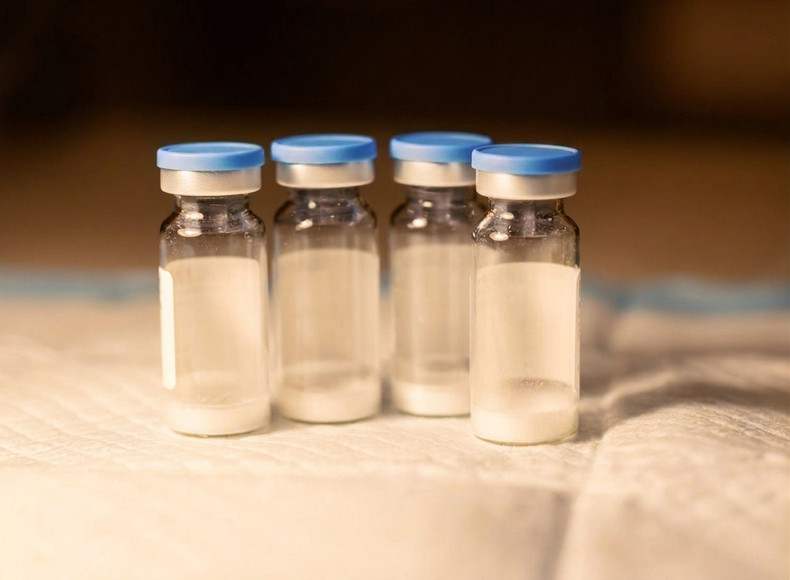
Many peptides are supplied dry because they are less stable after spending extended time in water. Lyophilization removes most of that water under controlled conditions and leaves the formulation as a solid, slowing molecular movement and several degradation pathways that can proceed more readily in solution. The useful lifetime still depends on the peptide, formulation, residual moisture, container, temperature, and storage history; freeze-drying creates a more manageable starting state rather than an indestructible product.
The dry material at the bottom of a vial is the result of a manufacturing cycle with three connected stages. Understanding those stages explains both the advantage of the format and the variations people see when they look through the glass.
The freeze-drying cycle
The process begins with a liquid formulation containing the peptide and any selected excipients. During freezing, water forms ice crystals while the peptide, salts, buffers, and other dissolved components become concentrated in the remaining unfrozen regions. The solidifying matrix reduces molecular mobility, but the freezing step also creates stresses: local concentrations rise, some buffer components can crystallize before others, pH can shift, and molecules can encounter ice-water interfaces.
Primary drying begins after the formulation is frozen. The chamber pressure is lowered and controlled heat is supplied so the ice changes directly from solid to vapour, a process called sublimation. The vapour leaves through pores created by the ice crystals. Product temperature has to remain below the formulation's collapse threshold; too much heat can damage the structure, while too little makes an already slow stage take longer.
After the visible ice is gone, some water remains associated with the dried solids. Secondary drying uses continued low pressure and a carefully controlled increase in temperature to remove part of that water by desorption. The intended residual-moisture range is formulation-specific. Excess moisture can increase molecular mobility and chemical degradation, while removing water too aggressively can also disturb structures that rely on particular hydration interactions.
At the end of a suitable cycle, the vial contains a porous solid matrix rather than a liquid. It may be sealed under vacuum or an inert gas to reduce later exposure to moisture and reactive gases. The complete process is more precise than simply freezing a vial and pulling a vacuum; freezing rate, shelf temperature, chamber pressure, time, formulation composition, and fill volume all influence the finished solid.
Stability in the dry state
Water participates directly in hydrolysis and also gives molecules, ions, oxygen, and trace reactants more freedom to move and encounter one another. Depending on the sequence and conditions, a peptide in solution may undergo hydrolysis, oxidation, deamidation, isomerization, or aggregation. Temperature, pH, concentration, light, dissolved oxygen, surfaces, and agitation can change the rate and importance of those pathways.
Freeze-drying removes most water and can hold the formulation in a rigid, glass-like or crystalline matrix. Lower molecular mobility reduces the frequency of the interactions required for many degradation reactions. This is why a carefully developed dry formulation can have a longer useful storage interval than the same peptide held continuously in solution.
The benefit comes from the formulation and cycle working together. Freezing and dehydration can themselves promote aggregation or structural change. Sugars and polyols may help replace stabilizing water interactions or form a protective glassy matrix, while materials such as mannitol or glycine may provide bulk and influence cake structure. Buffers, counterions, and other excipients can affect pH, crystallization, residual moisture, and how the solid behaves later.
This composition also explains why visible cake size cannot be read as peptide mass. The dried structure can contain peptide, counterions, salts, bulking agents, stabilizers, and residual water. Ice-crystal history and fill geometry influence the space it occupies. Our separate article on large and small lyophilized cakes covers that appearance question without using it as a substitute for quantitative testing.
The aqueous storage interval
A ready-made liquid begins its time in the more mobile aqueous state before it reaches the receiving laboratory. Its stability then depends on concentration, pH, buffer, preservatives or other excipients, oxygen exposure, light, temperature, agitation, container surfaces, shipping time, and the length of storage already elapsed. Establishing a useful lifetime requires data for that exact solution and container under defined conditions.
A dry presentation postpones that aqueous interval. It allows the longer period of inventory storage and transport to occur in a state that may better control several degradation routes, then lets a laboratory prepare material at the point required by its own validated workflow. The format does not eliminate temperature or moisture sensitivity, and it does not create one storage rule for every peptide.
The practical reason for supplying many peptides dry is therefore chemical rather than cosmetic. Lyophilization moves the formulation from a mobile solution into a controlled solid matrix, which can slow water-dependent and diffusion-dependent changes during storage. Its success is demonstrated by formulation-specific stability data, while the dry cake itself remains a physical result of the process rather than a visual assay of identity, purity, or peptide content.
Sources and context
- The FDA inspection guide defines freezing, primary drying by sublimation, and secondary drying by desorption and discusses process controls and the stability rationale: Lyophilization of Parenteral.
- A recent formulation review explains freezing and dehydration stresses, protective excipients, residual moisture, collapse temperature, and the roles of primary and secondary drying: Practical advice in the development of a lyophilized protein drug product.
- A review of pharmaceutical protein solids covers solid-state stability, molecular mobility, process stress, and the influence of formulation and drying conditions: Pharmaceutical protein solids.
- The 2023 freeze-drying process review describes how freezing conditions shape cake structure and how primary- and secondary-drying parameters affect the final product: Practical Advice on Scientific Design of Freeze-Drying Process.
- A peptide-stability review discusses sequence, concentration, pH, excipients, chemical modification, surfaces, pressure, temperature, agitation, and lyophilization as interacting factors: Factors affecting the physical stability of peptide therapeutics.
Research-use notice: Precision Synthetics Canada products and documentation are provided strictly for lawful, non-clinical laboratory research purposes only. COAs and testing records are not medical documents, safety guarantees, sterility guarantees, therapeutic endorsements, dosing guidance, or approval for human or veterinary use.