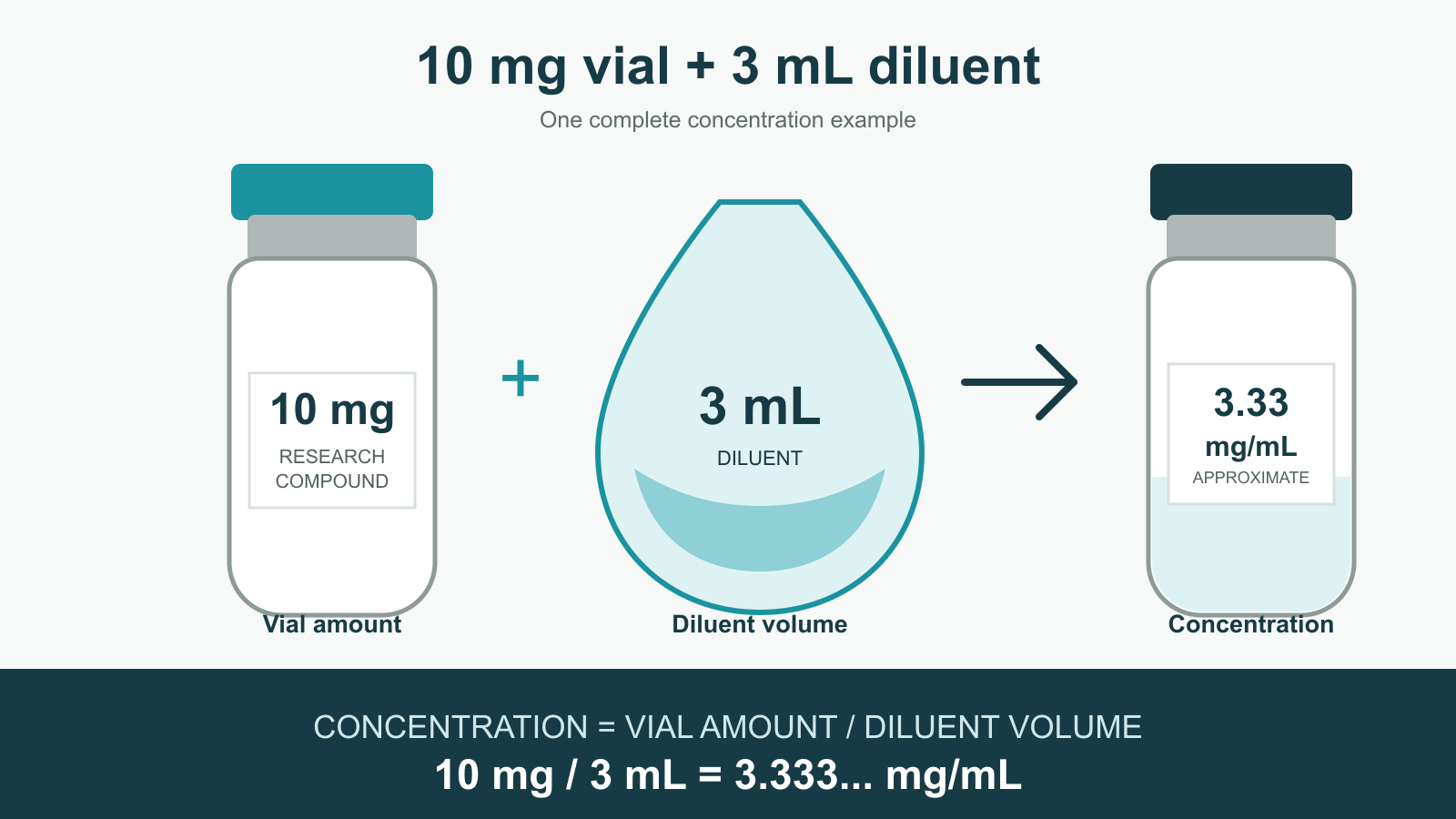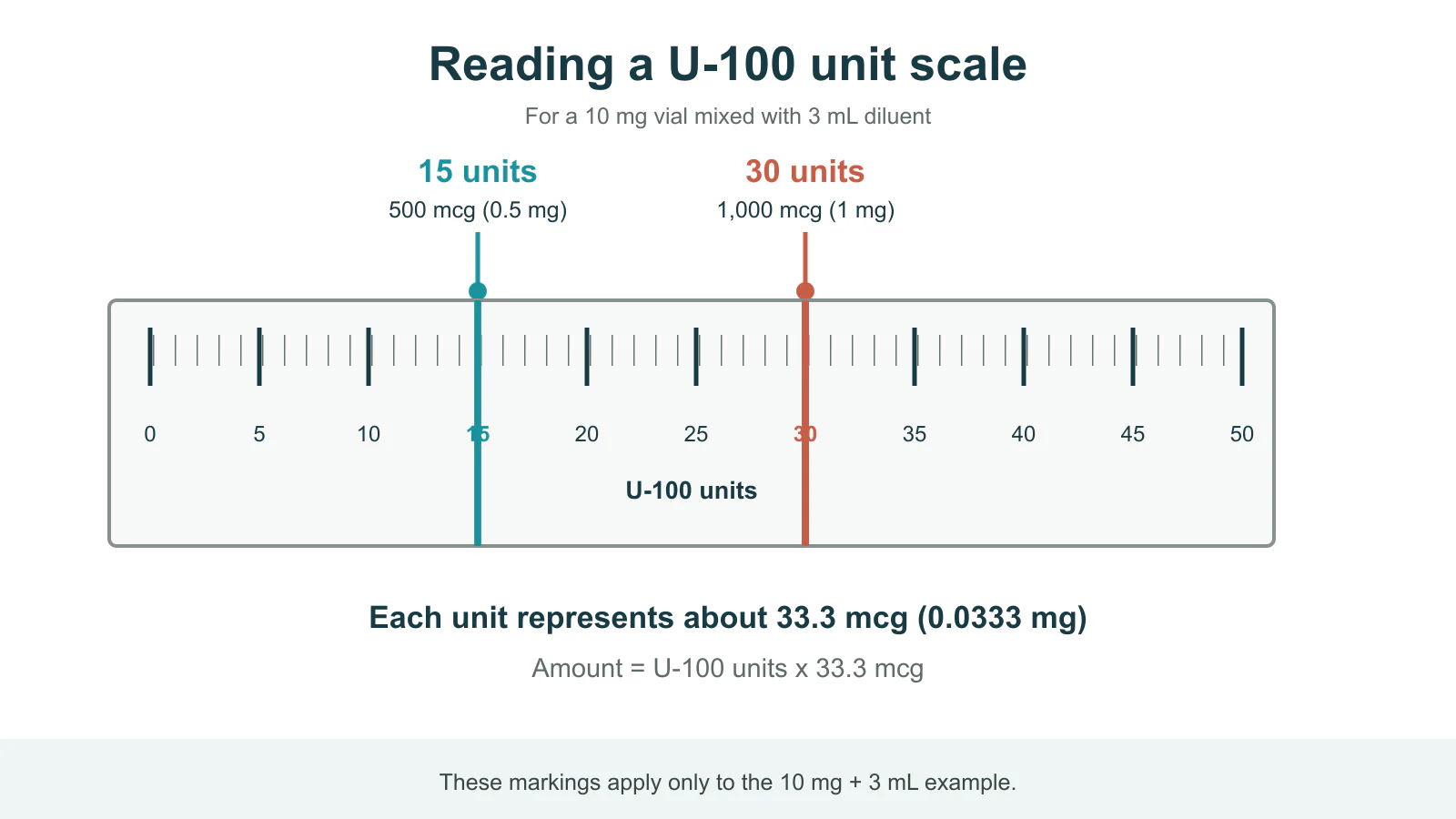

Reconstitution math can look intimidating at first, but most of it comes down to one simple relationship: how much material is present, and how much liquid it is dissolved in.
For research labs, that relationship matters because a lyophilized peptide does not become a useful stock solution until the concentration is known. Once a dry research material is brought into solution, the lab needs a clear way to describe what was prepared. That concentration may be recorded in mg/mL, µg/mL, mM, µM, or nM depending on the experiment and the way the assay is designed.
The math does not need to be complicated, but it does need to be handled carefully. A small unit mistake can turn into a large concentration error, especially when working with milligrams, micrograms, microlitres, and molar units.
This article explains the basic concentration calculations in plain English, using research-lab examples only.
What Reconstitution Means in a Lab Setting
Reconstitution is the process of adding a measured liquid volume to a dry material so it becomes a solution.
For lyophilized peptides, the dry material may appear as a powder, film, or compact cake in the vial. Once an appropriate lab solvent is added according to the research protocol, the peptide is brought into solution and becomes a stock solution.
A stock solution is simply the concentrated solution prepared first. It is often too concentrated for direct use in an assay, so the lab may later dilute it into a lower working concentration.
That distinction matters. Reconstitution creates the stock. Dilution adjusts that stock for a specific research workflow.
The Core Formula: Mass Divided by Volume
The most common concentration calculation is:
Concentration = mass ÷ volume
For peptide stock solutions, this is often written as:
Concentration in mg/mL = peptide mass in mg ÷ liquid volume in mL
For example, if a lab has 10 mg of peptide material and brings it into solution with 2 mL of liquid, the stock concentration is:
10 mg ÷ 2 mL = 5 mg/mL
That means every 1 mL of the prepared stock contains 5 mg of peptide, assuming the material is fully dissolved and evenly mixed.
The same formula works in reverse. If a lab knows the desired stock concentration, it can calculate the volume needed:
Volume in mL = peptide mass in mg ÷ desired concentration in mg/mL
So if the lab has 10 mg and wants a 2 mg/mL stock:
10 mg ÷ 2 mg/mL = 5 mL
The math is simple, but the units must stay consistent. Milligrams should be paired with millilitres if the final answer is mg/mL. Micrograms should be paired with millilitres if the final answer is µg/mL.
Why Units Cause Most Mistakes
Most concentration errors are not caused by difficult math. They are caused by unit confusion.
The difference between milligrams and micrograms is easy to overlook, but it is a 1,000-fold difference. One milligram equals 1,000 micrograms. The same kind of issue happens with millilitres and microlitres. One millilitre equals 1,000 microlitres.
This is why a concentration written as 1 mg/mL can also be written as 1,000 µg/mL. Those two values are the same concentration expressed in different units.
A helpful habit is to convert everything into one unit system before doing the calculation. If the peptide amount is listed in milligrams and the liquid volume is measured in millilitres, mg/mL is usually the easiest starting point. If the assay uses microlitre transfers, the final pipetting volumes can be converted afterward.
For example, a 5 mg/mL stock is the same as 5,000 µg/mL. Since 1 mL equals 1,000 µL, that also means the stock contains 5 µg per µL.
That last conversion is useful in lab planning because many transfers are measured in microlitres.
Calculating How Much Stock Contains a Target Amount
Once the stock concentration is known, the next common question is how much stock solution contains a certain amount of peptide.
The formula is:
Volume needed = target amount ÷ stock concentration
For example, if a stock solution is 5 mg/mL and a lab needs 1 mg of material for a research preparation, the calculation is:
1 mg ÷ 5 mg/mL = 0.2 mL
Since 0.2 mL equals 200 µL, the lab would measure 200 µL of that stock solution to obtain 1 mg of peptide.
This is a research concentration calculation, not an administration instruction. The point is to understand the relationship between concentration, amount, and measured lab volume.
Reconstitution vs Dilution
Reconstitution and dilution are often talked about together, but they are not the same step.
Reconstitution takes the dry material and turns it into a stock solution. Dilution takes that stock solution and reduces it to a lower concentration by adding more solvent or buffer.
The basic dilution formula is:
C1 × V1 = C2 × V2
In plain English, this means the starting concentration multiplied by the starting volume equals the final concentration multiplied by the final volume.
C1 is the concentration of the stock solution. V1 is the volume of stock needed. C2 is the desired final concentration. V2 is the desired final volume.
For example, suppose a lab has a 5 mg/mL stock and wants to prepare 1 mL of a 0.5 mg/mL working solution.
The calculation would be:
V1 = C2 × V2 ÷ C1
V1 = 0.5 mg/mL × 1 mL ÷ 5 mg/mL
V1 = 0.1 mL
Since 0.1 mL equals 100 µL, the lab would combine 100 µL of stock with enough diluent to reach a final total volume of 1 mL. In this example, that would mean 100 µL of stock plus 900 µL of diluent.
This kind of dilution planning is common in laboratory workflows because stock solutions are often prepared at a higher concentration than the final working solution needed for an assay.
When Molar Concentration Matters
Some research workflows do not use mg/mL as the main concentration unit. Instead, they use molar units such as mM, µM, or nM.
Molar concentration describes how many molecules are present in a given volume. This can be useful because two peptides can have the same mass concentration but different numbers of molecules if their molecular weights are different.
Molecular weight is the bridge between mass-based concentration and molar concentration. It tells you how heavy one mole of the molecule is, usually written as g/mol.
The most useful conversion is:
µM = µg/mL × 1,000 ÷ molecular weight
For example, if a peptide stock is 100 µg/mL and the peptide has a molecular weight of 1,000 g/mol, the molar concentration is:
100 × 1,000 ÷ 1,000 = 100 µM
If the molecular weight were 2,000 g/mol instead, the same 100 µg/mL stock would be:
100 × 1,000 ÷ 2,000 = 50 µM
That is why molecular weight matters. The same mass does not always equal the same number of molecules.
Why Molecular Weight Should Be Checked Carefully
Molecular weight should not be guessed. It should come from a reliable product record, sequence record, or documentation source.
For peptides, small differences in sequence, salt form, modification, or counterion can change the molecular weight used in calculations. In many research contexts, the calculation may use the peptide’s stated molecular weight from the product documentation, but labs should be clear about which value they are using and why.
This is especially important when converting into molar units. A small difference in molecular weight may not matter much for a rough mass-based stock calculation, but it can affect molar concentration reporting.
For clean recordkeeping, it is worth writing down the molecular weight used in the calculation, not just the final concentration.
Accounting for Labelled Amount vs Measured Amount
Many basic examples assume the labelled amount is the amount being used in the calculation. For example, a vial labelled 10 mg is treated as 10 mg.
In real documentation review, a lab may also consider whether the COA reports a measured content value. If the analytical report provides fill or assay information, the lab may decide which value is appropriate for its own calculations and records.
The important part is consistency. If the calculation uses the labelled amount, record that. If it uses a measured amount from documentation, record that instead. Mixing the two without noting the difference can make the preparation harder to understand later.
For research work, clear records are part of the calculation. The math tells you the concentration, but the notes explain how that concentration was determined.
Small Volumes Can Create Big Errors
A calculation can be correct on paper and still be difficult to perform accurately in the lab.
Very small volumes are one of the most common issues. If a calculation tells you to transfer 1 µL, 2 µL, or 3 µL, the math may be technically correct, but the pipetting error may be too large for the workflow. Many labs avoid extremely small transfer volumes unless they have the right equipment and validation for that range.
One practical way to reduce this problem is to prepare an intermediate dilution. Instead of trying to pipette a tiny volume from a very concentrated stock, the lab first makes a lower-concentration intermediate stock, then uses that intermediate to prepare the final working solution.
This adds a step, but it can make the work more accurate and easier to repeat.
Lab Records Matter as Much as the Calculation
Good concentration math should be written down clearly enough that someone else can understand it later.
A useful lab note should include the peptide name, batch or lot identifier, starting mass, solvent or buffer used, final volume, calculated concentration, date prepared, storage conditions, and the person who prepared it. If molar concentration is used, the molecular weight should also be recorded.
That may sound like a lot, but it prevents confusion later. A tube labelled only “peptide stock” is not very helpful. A tube labelled with the compound name, concentration, solvent, date, and batch reference is much easier to manage in a research setting.
The same applies to aliquots. If a stock solution is divided into smaller tubes, each aliquot should carry enough information to identify what it is and how it was prepared.
A Simple Concentration Example From Start to Finish
Here is a straightforward research example.
A lab has a vial containing 10 mg of lyophilized peptide material. The lab adds 2 mL of solvent to prepare the initial stock solution.
The stock concentration is:
10 mg ÷ 2 mL = 5 mg/mL
The lab then wants to prepare 1 mL of a 0.5 mg/mL working solution.
Using the dilution equation:
V1 = C2 × V2 ÷ C1
V1 = 0.5 mg/mL × 1 mL ÷ 5 mg/mL
V1 = 0.1 mL
That means 0.1 mL, or 100 µL, of the 5 mg/mL stock is used, then diluent is added until the final volume reaches 1 mL.
The final working solution is 0.5 mg/mL.
This example shows the basic flow: first calculate the stock concentration, then use that stock concentration to calculate any later dilution.
Where a Peptide Calculator Fits In
A peptide calculator can make routine concentration math faster, especially when switching between mg, mL, µg/µL, and molar units. It is still helpful to understand the math behind the calculator, though, because the calculator can only work with the numbers entered into it.
If the wrong mass, volume, molecular weight, or unit is entered, the final answer will still be wrong. The calculator helps with arithmetic, but the researcher still has to choose the right inputs.
That is why the best approach is to understand the formula first, then use a calculator as a convenience tool.
Common Calculation Mistakes to Avoid
A few mistakes come up often in concentration planning. The most common is mixing up milligrams and micrograms, which creates a 1,000-fold error. Another is mixing up millilitres and microlitres, which creates the same kind of problem on the volume side.
Another common issue is calculating the amount of stock to transfer without accounting for the final total volume. In dilution math, the final concentration depends on the total final volume, not just the amount of diluent added.
It is also easy to forget that molar concentration requires molecular weight. Without molecular weight, a lab can calculate mg/mL or µg/mL, but not mM, µM, or nM.
Finally, concentration calculations should not be separated from the batch record. If a stock was prepared from a specific vial, the batch or lot information should be recorded with the preparation.
Why This Matters for Research Buyers
Reconstitution math is not just a technical detail. It is part of how research materials are handled responsibly in a laboratory setting.
A buyer reviewing a peptide should understand the labelled amount, the available COA, the batch documentation, and the concentration calculations needed for the intended research workflow. The better those pieces fit together, the easier it is to prepare clear records and reduce avoidable mistakes.
Precision Synthetics Canada provides research-use materials with documentation intended to support that kind of review. Buyers can review available COAs, read testing information, and use calculation tools to better understand concentration planning before moving into their own laboratory workflow.
Review the Documentation Before Calculating
Before preparing a stock solution, it is worth checking the available product documentation. The COA can help confirm the batch record, identity-supporting information, purity data, and other testing details that may be relevant to the lab’s notes.
You can review available batch documentation in our COA library. For help understanding COA fields such as HPLC purity, LC-MS identity support, LAL endotoxin screening, and batch traceability, read our guide on how to read a peptide COA.
For routine concentration planning, our peptide calculator can also help with common mass, volume, and concentration conversions.
Research-use notice: Precision Synthetics Canada products and documentation are provided strictly for lawful, non-clinical laboratory research purposes only. This article is provided for general laboratory calculation education and is not medical advice, dosing guidance, administration guidance, compounding instruction, sterility guidance, or approval for human or veterinary use.